


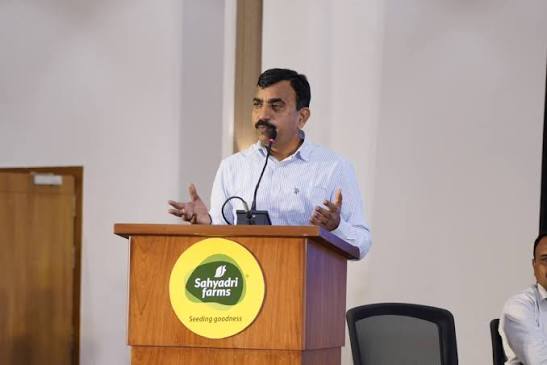
From a small farming family in Nashik and an early business setback to a ₹2,609 crore farmer-owned enterprise, Vilas Shinde’s journey demonstrates how collective farming, investment in infrastructure and global market access can transform Indian agriculture.
In Nashik, Maharashtra, grapes have long been more than an agricultural crop. They represent livelihoods, entrepreneurship and an important connection between Indian farmers and international markets.
One of the most remarkable stories to emerge from this agricultural landscape is that of Vilas Shinde, Founder and Chairman of Sahyadri Farms.
Under his leadership, what began as an initiative to improve the economic position of small farmers developed into one of India’s largest farmer-owned horticulture businesses and a major fresh-produce exporter.
Today, Sahyadri Farms has an extensive network of farmers, advanced post-harvest infrastructure, processing facilities and international customers. Its consolidated income reached ₹2,609.27 crore in FY 2025–26, marking growth of 33.5% over the previous financial year.
Behind these numbers is a business philosophy built around a simple idea: farmers should not remain only producers of agricultural commodities; they should also participate in the value created through processing, marketing and international trade.
The Beginning: A Farmer Who Wanted to Change the Economics of Farming
Vilas Shinde’s journey began in a farming family in Nashik.
With an agricultural engineering background, he understood the practical challenges faced by smallholder farmers. Fragmented landholdings, unpredictable agricultural income, limited market access and dependence on intermediaries made it difficult for individual farmers to build sustainable businesses.
His early entrepreneurial experiences were not easy.
An initial attempt at dairy farming and other agricultural activities resulted in financial difficulties and substantial debt. Rather than abandoning agriculture, Shinde began looking more closely at the economics of farming and the possibilities of collective business development.
He recognised that individual farmers often lacked the scale required to access better markets, invest in technology and manage the complexities of agricultural exports.
His response was to bring farmers together.
In 2004, he began organising grape growers to explore direct exports. The initial effort faced serious setbacks, including rejected consignments in the Netherlands. The experience exposed the importance of international quality standards, market understanding and buyer relationships.
Shinde personally travelled to the Netherlands to understand what had gone wrong. The losses were substantial, and he reportedly sold his own land to repay participating farmers.
It was a difficult chapter, but it helped shape the business philosophy that would guide Sahyadri Farms: international markets require professional systems, consistent quality and collective responsibility.
2010–2011: The Formation of Sahyadri Farms
The formal journey of Sahyadri Farmers Producer Company took shape around 2010–2011.
Four smallholder farmers led by Vilas Shinde began building an organisation based on collective participation.
The objective was to create a farmer-owned enterprise capable of providing services that individual farmers could not easily establish independently.
Rather than focusing only on the purchase and sale of agricultural produce, the organisation gradually developed an integrated agricultural value chain.
Its activities expanded across:
- Farmer mobilisation and organisation.
- Agricultural advisory and technical guidance.
- Quality management and crop planning.
- Harvesting and produce aggregation.
- Sorting, grading and packaging.
- Cold storage and post-harvest management.
- Fresh-produce exports.
- Food processing and value-added products.
- Domestic and international marketing.
The approach helped connect small farms with larger commercial supply chains.
The company drew inspiration from the cooperative philosophy associated with Amul, while developing its own farmer-producer-company structure suited to horticulture.
Building Infrastructure: Taking Grapes from Farms to Global Markets
Fresh grape exports require much more than growing good-quality fruit.
International buyers expect consistency in variety, size, colour, appearance, residue levels, food safety, traceability, packaging and delivery schedules.
For a business working with thousands of farmers, maintaining these standards requires significant investment in infrastructure and operational systems.
Sahyadri Farms gradually developed an integrated facility at Mohadi in Nashik.
Its infrastructure includes:
Modern packhouse facilities: For receiving, sorting, grading, packing and preparing fresh produce for domestic and international markets.
Cold-chain infrastructure: To manage temperature-sensitive agricultural products and maintain quality during storage and transportation.
Processing facilities: For converting agricultural produce into frozen, aseptic and other value-added products.
Agricultural advisory: To support farmers with crop management, cultivation practices and export-quality production.
Technology and traceability: Digital systems help coordinate agricultural activities and track produce across the supply chain.
The company also expanded beyond grapes into pomegranates, bananas, mangoes, citrus, tomatoes, sweetcorn and other agricultural products.
This diversification helped create a broader business model in which fresh exports, domestic distribution and food processing support the overall agricultural enterprise.
Institutional Investment: Capital for the Next Stage of Growth
One of the important milestones in Sahyadri Farms’ development was its ability to attract institutional investment while retaining a farmer-majority ownership structure.
In 2022, Sahyadri Farms Post Harvest Care Limited raised approximately ₹310 crore from a consortium of impact-focused investors led by Incofin.
The investment consortium included:
- Incofin Investment Management
- Korys
- Proparco
- FMO, the Dutch entrepreneurial development bank
The capital raise was an important development for India’s farmer-owned enterprise ecosystem.
It demonstrated that an organisation built around smallholder farmers could attract institutional capital to expand infrastructure, technology, processing and market access.
The investment was associated with the company’s post-harvest business structure, rather than simply being a direct investment into individual grape farms.
Sahyadri’s broader infrastructure investment has also been substantial. The company’s FY 2022–23 disclosures reported infrastructure assets of approximately ₹558 crore.
These investments helped strengthen the facilities and systems required to manage agricultural produce at commercial scale.
The company’s ownership structure has continued to retain significant farmer participation, while external institutional investors have supported the expansion of its post-harvest business.
The Latest Financial Milestone: ₹2,609 Crore Consolidated Income
Sahyadri Farms’ growth is reflected in its latest reported financial performance.
At its 16th Annual General Meeting in October 2026, Sahyadri Farmers Producer Company Limited reported consolidated income of ₹2,609.27 crore for FY 2025–26.
This represented 33.5% growth compared with ₹1,954.73 crore in FY 2024–25.
Sahyadri Farms: Financial Growth
| Financial Year | Consolidated Income |
|---|---|
| FY 2024–25 | ₹1,954.73 crore |
| FY 2025–26 | ₹2,609.27 crore |
Latest FY 2025–26 operating highlights:
- 30,302 farmers engaged.
- 53,322 acres under the farmer network.
- 446,335 tonnes of agricultural produce procured.
- 33.5% year-on-year growth in consolidated income.
- 7,228 direct employees, including 2,355 women.
The company achieved this growth despite challenges faced by agricultural producers, including unseasonal rainfall in Maharashtra and disruption to international logistics and trade flows.
These figures reflect the wider Sahyadri agricultural business, including multiple crops, processing and domestic and international operations. They should not be interpreted as grape-export revenue alone.
India’s Largest Grape Exporter: A Global Market Presence
Grapes remain central to Sahyadri Farms’ identity and export development.
The company has established a strong presence in international fresh-produce markets and describes itself as India’s largest table-grape exporter.
Its export journey began with European markets, where the company developed relationships with buyers and retailers requiring consistent quality, food-safety compliance and reliable supply.
Sahyadri’s wider international business now serves customers across more than 40 countries, according to company information.
Its major international market regions include:
Europe
- Netherlands
- Germany
- Belgium
- United Kingdom
Middle East
- United Arab Emirates
- Saudi Arabia
- Oman
North America
- United States
- Canada
Asia and other markets
- Japan
- China
- Southeast Asian markets
These destinations reflect the company’s broader fresh-produce and processed-food presence. They should not all be interpreted as grape destinations specifically.
Netherlands: An Important European Connection
The Netherlands has played an important role in the development of India’s grape-export trade.
For Sahyadri Farms, the Dutch market also has a special place in its history. Its early experience with rejected grape consignments helped the organisation understand the importance of meeting international buyer expectations.
Today, the Netherlands is one of India’s major fresh-grape export destinations and an important European distribution market.
The experience highlights how export businesses must develop not only agricultural production but also market intelligence, buyer relationships, quality assurance and logistics.
Russia: A Market Worth Exploring
Russia is another important destination for Indian fresh grapes.
India’s grape exports to Russia have established a commercial foundation for further engagement between Indian suppliers and Russian importers.
Russian trade representatives have also expressed interest in increasing agricultural imports from India, including grapes.
For exporters, this creates an opportunity to examine buyer requirements, seasonal demand, varieties, packaging, pricing and logistics.
Sahyadri Farms’ experience in international grape markets offers a useful example of the scale, organisation and quality systems required to serve overseas customers.
However, market interest should not be confused with confirmed purchase orders. Every exporter must independently establish commercial terms and buyer requirements.
Beyond Grapes: Building a Complete Horticulture Value Chain
A major strength of Sahyadri Farms is its decision to expand beyond fresh grape exports.
The company has developed capabilities across several agricultural categories, including:
- Grapes
- Pomegranates
- Mangoes
- Bananas
- Citrus fruits
- Tomatoes
- Sweetcorn
- Other fruits and vegetables
It has also invested in value-added processing, including frozen and aseptic products and food ingredients.
This diversification is strategically important.
Fresh agricultural products are seasonal and vulnerable to weather conditions, market fluctuations and post-harvest losses.
Processing can create additional commercial uses for agricultural produce and help businesses participate in different segments of the food supply chain.
It also creates opportunities for Indian agriculture to move from exporting raw commodities towards supplying processed products and ingredients to international manufacturers and retailers.
Technology, Traceability and Farmer Participation
Sahyadri Farms has increasingly used technology to strengthen its agricultural operations.
Its digital platforms, including FarmSetu for farmer and crop advisory and Vesatogo for supply-chain traceability, support coordination between farmers and the wider business.
Technology and data can help monitor crop conditions, improve traceability and manage the movement of agricultural produce.
The company’s farmer-owned structure is another important part of its model.
According to its published information, Sahyadri has built a network of more than 30,000 registered farmers.
This model creates a connection between agricultural production and the commercial organisation responsible for quality, processing and market access.
The objective is to enable smallholder farmers to participate in a more organised agricultural business rather than remain isolated producers selling independently.
Vilas Shinde’s Contribution to Indian Agriculture
The significance of Vilas Shinde’s journey extends beyond the financial growth of one company.
He identified a structural challenge in Indian agriculture: small farmers often produce quality agricultural commodities but lack the collective infrastructure and commercial strength needed to compete internationally.
His response was to develop a farmer-owned business that combines agricultural production with professional management, technology, processing and international marketing.
The journey involved early financial setbacks, rejected export consignments, investment decisions, organisational development and the difficult task of building trust among farmers.
Sahyadri Farms demonstrates how collective ownership can be combined with commercial discipline and institutional investment.
It also provides an example for other Farmer Producer Organisations and Farmer Producer Companies seeking to develop organised value chains for agricultural products.
The Road Ahead: Connecting Indian Farmers with More Global Markets
As international demand for fresh produce, traceable agricultural products and processed food continues to create new commercial possibilities, organised Indian agricultural enterprises have an important role to play.
For Sahyadri Farms, the next stage involves strengthening farmer participation, developing climate-resilient agriculture, expanding value addition and maintaining relationships with international customers.
For Indian agricultural exporters more broadly, the company’s journey offers several lessons:
- Organise farmers before attempting to scale exports.
- Invest in quality and post-harvest infrastructure.
- Understand international buyer requirements.
- Build reliable cold-chain and logistics systems.
- Use technology to improve traceability and supply-chain management.
- Develop value-added products alongside fresh exports.
- Build long-term commercial relationships rather than relying on seasonal transactions.
From Nashik to the World
Vilas Shinde’s journey with Sahyadri Farms is a story of determination, collective enterprise and a different approach to agricultural business.
From early setbacks in grape exports to a farmer-owned enterprise reporting more than ₹2,600 crore in consolidated annual income, the journey shows what can happen when farmers become partners in building the business that takes their produce to market.
Sahyadri Farms is not simply a story about exporting grapes. It is a story about building an agricultural ecosystem in which farmers, infrastructure, technology, investment and international markets work together.
For India’s agricultural export sector, that is an achievement worth recognising.
THE EXIM TIMES
Independent Trade Media for the Export-Import Industry.