


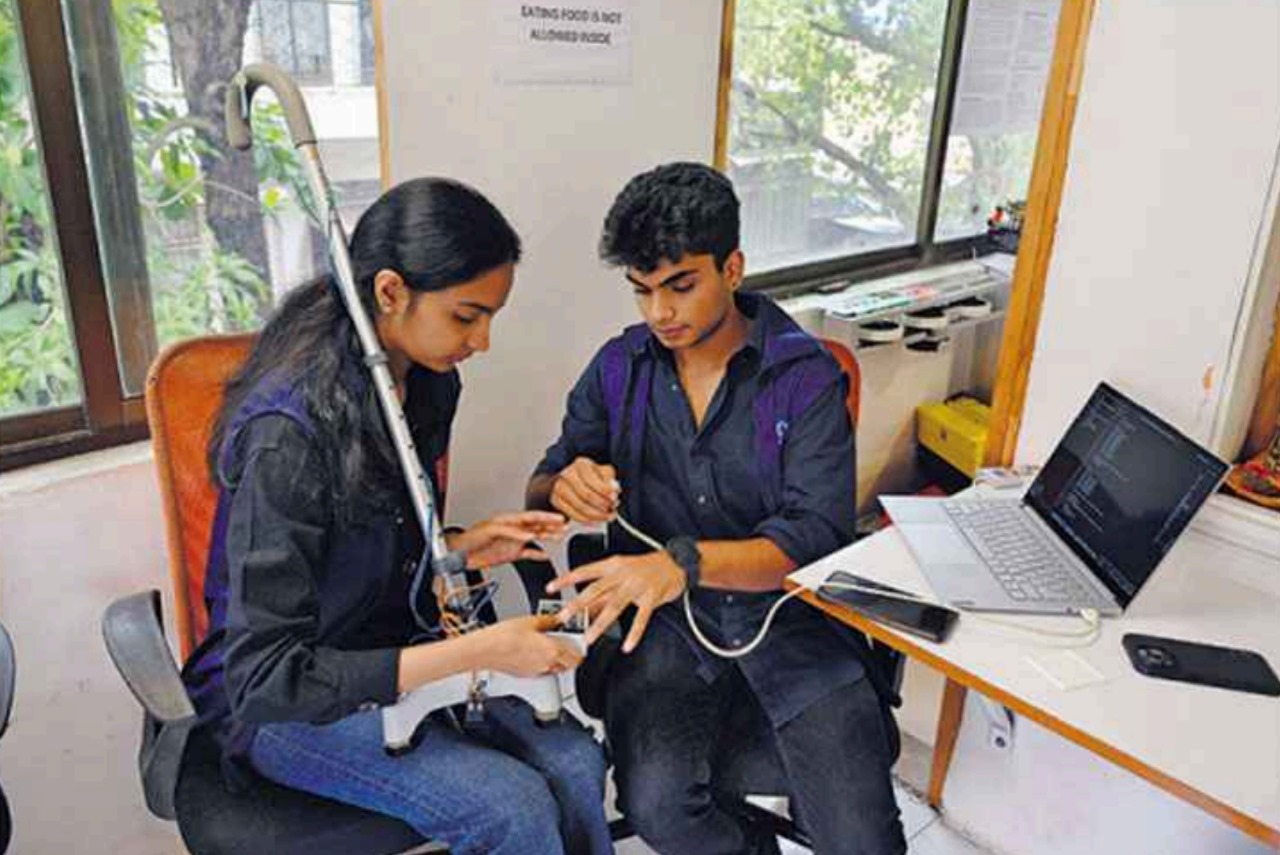
A simple idea inspired by their grandparents led two young innovators to develop Walkfit, a sensor-based attachment designed to help monitor walking patterns and identify potential fall risks.
Sometimes, an important innovation begins with something that happens close to home.
For Mumbai students Rahi Shah and Hriday Boriawala, seeing their grandparents experience mobility challenges prompted a question: could technology help older people walk with greater confidence and allow changes in their movement to be better understood?
Their answer was Walkfit, a smart attachment designed to fit onto a conventional walking stick.
Rather than replacing an everyday mobility aid with an entirely new device, the students explored how sensors and data could add another layer of information to something people already use.
An Everyday Object, Rethought
A walking stick provides physical support, but changes in how someone grips or places it can also offer clues about their movement.
Walkfit was developed to capture this information through pressure sensors and motion-related measurements. The collected data can be used to analyse walking patterns and highlight variations that may warrant further attention.
The concept brings together accessible hardware, sensor technology and an understanding of everyday mobility.
The idea is particularly interesting because it focuses on adapting a familiar product rather than requiring users to adopt a completely different mobility aid.
From a Personal Experience to a Product Idea
The project grew out of the students’ personal experiences with their grandparents. With guidance and support during development, they worked on turning the initial idea into a functional prototype.
Their work was also featured in Mid-day, which reported on the device’s pressure sensors and its potential to analyse movement and balance.
The story illustrates how everyday problems can provide a starting point for young innovators. A family concern became a technical challenge involving product design, electronics and the interpretation of movement data.
Why This Innovation Matters
Walkfit points towards a wider area of product development: assistive technology designed around the needs of older adults.
As engineers and entrepreneurs explore ways to make everyday products more useful, familiar objects can become platforms for new features. Sensors, connected devices and data analysis may help users, caregivers and healthcare professionals better understand particular needs.
However, a prototype is not the same as a clinically validated medical device. Its performance, affordability, usability and ability to identify fall risks must be assessed through appropriate testing before broader claims can be made.
A Lesson for Young Entrepreneurs
The story also offers a useful lesson beyond technology.
Innovation does not always begin with a large laboratory, an established company or a complicated business plan. It can begin by noticing a problem, asking whether it can be solved differently and working patiently towards a practical design.
For aspiring entrepreneurs and product developers, the next challenge is often turning a promising prototype into a reliable, manufacturable product that people can afford and use comfortably.
That journey requires engineering, testing, funding, manufacturing expertise and an understanding of the people who will eventually use the product.
When a Personal Problem Inspires a Bigger Idea
Walkfit is an example of how a familiar object can inspire a new approach to an everyday challenge.
Its story is not simply about a smarter walking stick. It is about recognising a need within one’s own family and exploring whether an idea could help others facing similar difficulties.
For young innovators, that may be one of the most valuable places to begin: with a real problem, a willingness to experiment and a product designed around people’s needs.
Editorial source: NITI Aayog Frontier Tech Hub, AI Assistive Tech for Elders: A Smart Attachment That Prevents Falls; Mid-day, Treating Mobility Disorders the AI Way.
About The Exim Times: Independent Trade Media for the Export-Import Industry.