


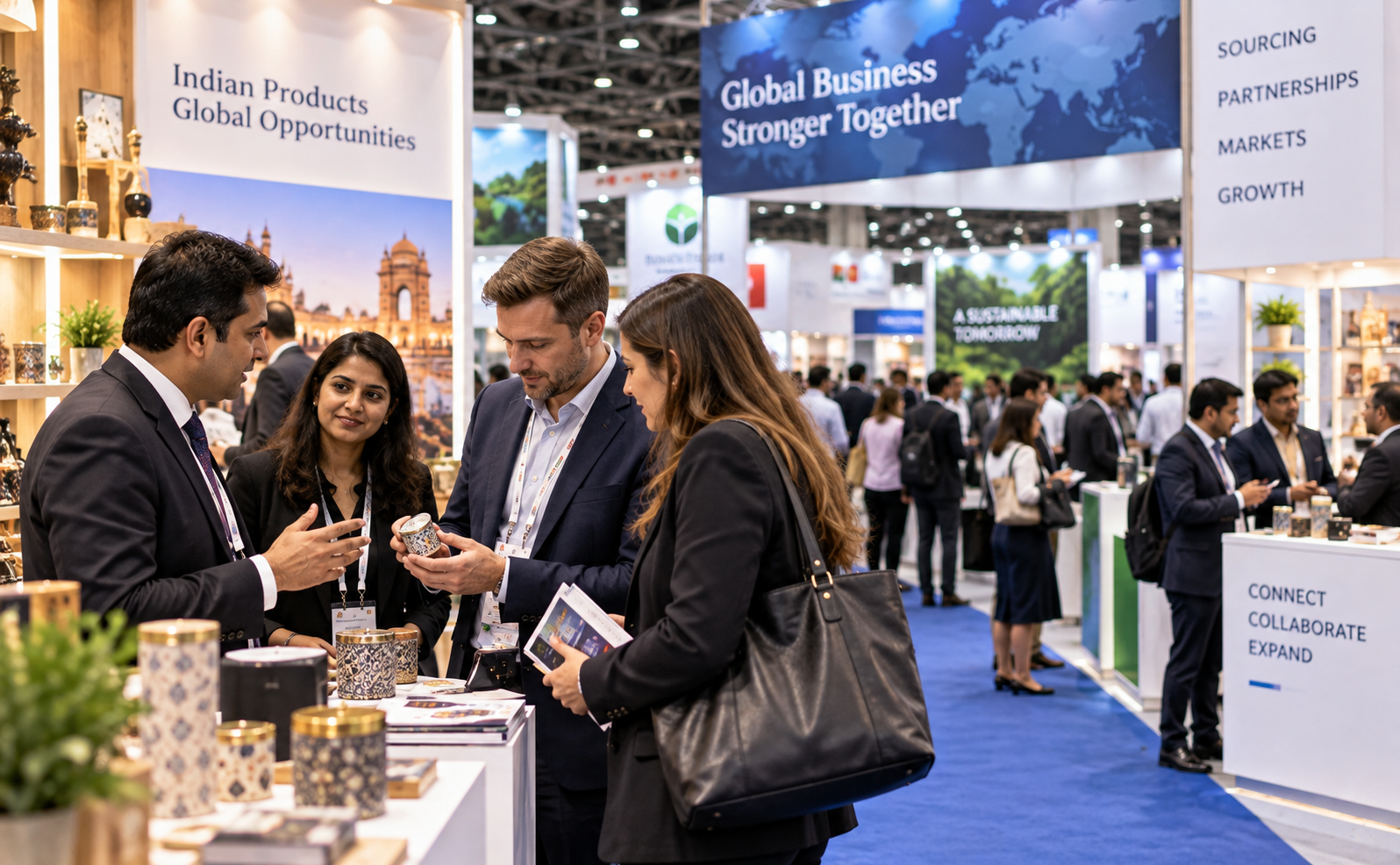
Trade events are no longer simply places to display products. For exporters, manufacturers and buyers, the exhibition floor can become a starting point for market discovery, business relationships and international opportunities.
For many businesses, attending a trade exhibition begins with a simple objective: find customers, suppliers or new products.
But the real value of a trade event often extends far beyond the exhibition booth.
A well-chosen trade event can bring together manufacturers, exporters, importers, distributors, buyers, technology providers, investors and industry institutions in one place. That concentration of business participants creates an environment where companies can discover markets, understand changing demand and begin relationships that may continue long after the event closes.
The Exhibition Floor Is a Market-Discovery Platform
Businesses entering a new market often face a basic challenge: understanding what the market actually wants.
Trade events can provide direct exposure to products, competitors, suppliers and business participants from different markets.
An exporter may discover that a product designed for one market has potential in another. A manufacturer may identify a new component supplier. An importer may find alternative sources for an existing product.
This makes trade events useful not only for selling, but also for learning where the next business opportunity may be.
Buyers and Sellers Meet in One Place
One of the strongest advantages of a B2B trade event is the concentration of relevant businesses.
Instead of searching separately for potential partners, participants can meet multiple companies during a single event.
For exporters, this can mean conversations with:
- Importers
- Distributors
- Wholesalers
- Retailers
- Sourcing companies
- Industry buyers
For buyers, the same environment can provide access to:
- Manufacturers
- Exporters
- New suppliers
- Alternative sourcing markets
- New products and technologies
The first conversation may not immediately produce a transaction. But it can establish the foundation for a commercial relationship.
Product Discovery Can Lead to New Markets
Trade events also work in the opposite direction.
A business may attend looking for a market and discover a product opportunity instead.
A buyer could identify a product category with growing potential. A manufacturer could discover an application for its product in another industry. An exporter could identify a country where competition, demand or distribution conditions appear attractive.
This is why product discovery and market discovery often happen together.
The Real Opportunity Often Begins After the Event
A trade event does not end when the exhibition closes.
The most important commercial work may begin afterwards.
Businesses need to evaluate:
- Which contacts were genuinely relevant?
- Which buyers showed serious interest?
- Which suppliers meet the required specifications?
- What quantities are involved?
- What markets should be researched further?
- Which meetings should continue?
- What samples, quotations or documents are required?
The difference between simply attending an exhibition and using it as a business-development platform is often the quality of the follow-up.
From Conversation to Business Relationship
Not every conversation becomes a deal.
But a conversation can become:
CONTACT → REQUIREMENT → DISCUSSION → VALIDATION → NEGOTIATION → BUSINESS RELATIONSHIP
That progression is particularly important in international trade, where trust, product specifications, pricing, compliance, logistics and payment terms can all influence a commercial decision.
Trade events can therefore serve as an important first point of contact rather than being viewed only as a place for immediate sales.
Why Smaller Trade Events Also Matter
The biggest international exhibitions attract enormous attention, but size alone does not determine business value.
A specialised or regional B2B event may bring together a smaller number of participants with much more focused requirements.
For example, a specialised event can make it easier for businesses to concentrate on a particular:
- Product
- Industry
- Buyer group
- Manufacturing cluster
- Market
- Technology
- Supply chain
For a company with a specific business objective, a focused event may sometimes be more useful than a much larger general exhibition.
The Business Behind the Exhibition
The exhibition itself is only one part of the ecosystem.
Behind the exhibition floor are manufacturers, buyers, suppliers, logistics companies, trade institutions, service providers, market researchers and business delegations.
Together, they create a wider network of commercial activity.
This is where trade-event coverage becomes more valuable than simply publishing event dates and venue information.
The important questions are:
Who is participating?
What are they looking for?
Which markets are represented?
What products are attracting attention?
What business requirements are emerging?
What opportunities could continue after the event?
Trade Events Can Become the Starting Point for Market Access
For businesses looking beyond their domestic market, the right trade event can provide a practical starting point for international market exploration.
It can help businesses move from:
MARKET INTEREST → MARKET DISCOVERY
PRODUCT INTEREST → PRODUCT DISCOVERY
CONTACT → BUSINESS RELATIONSHIP
EVENT PARTICIPATION → MARKET ACCESS
The real value therefore lies not simply in attending an exhibition, but in going with a clear business purpose.
The Next Generation of Trade Events
Trade events are increasingly becoming platforms where businesses can meet, discover, research, source, compare and build relationships.
For exporters and manufacturers, the exhibition floor can be a window into new markets.
For buyers, it can be a sourcing platform.
For suppliers, it can be a route to new customers.
And for trade institutions and service providers, it can become a place to understand where business demand is moving.
The Exim Times Perspective
A trade event should not be measured only by the number of exhibitors, visitors or exhibition halls.
The more important question is:
What business happens because the right people met there?
That is the story behind the exhibition — and increasingly, that is where the real trade opportunity begins.