


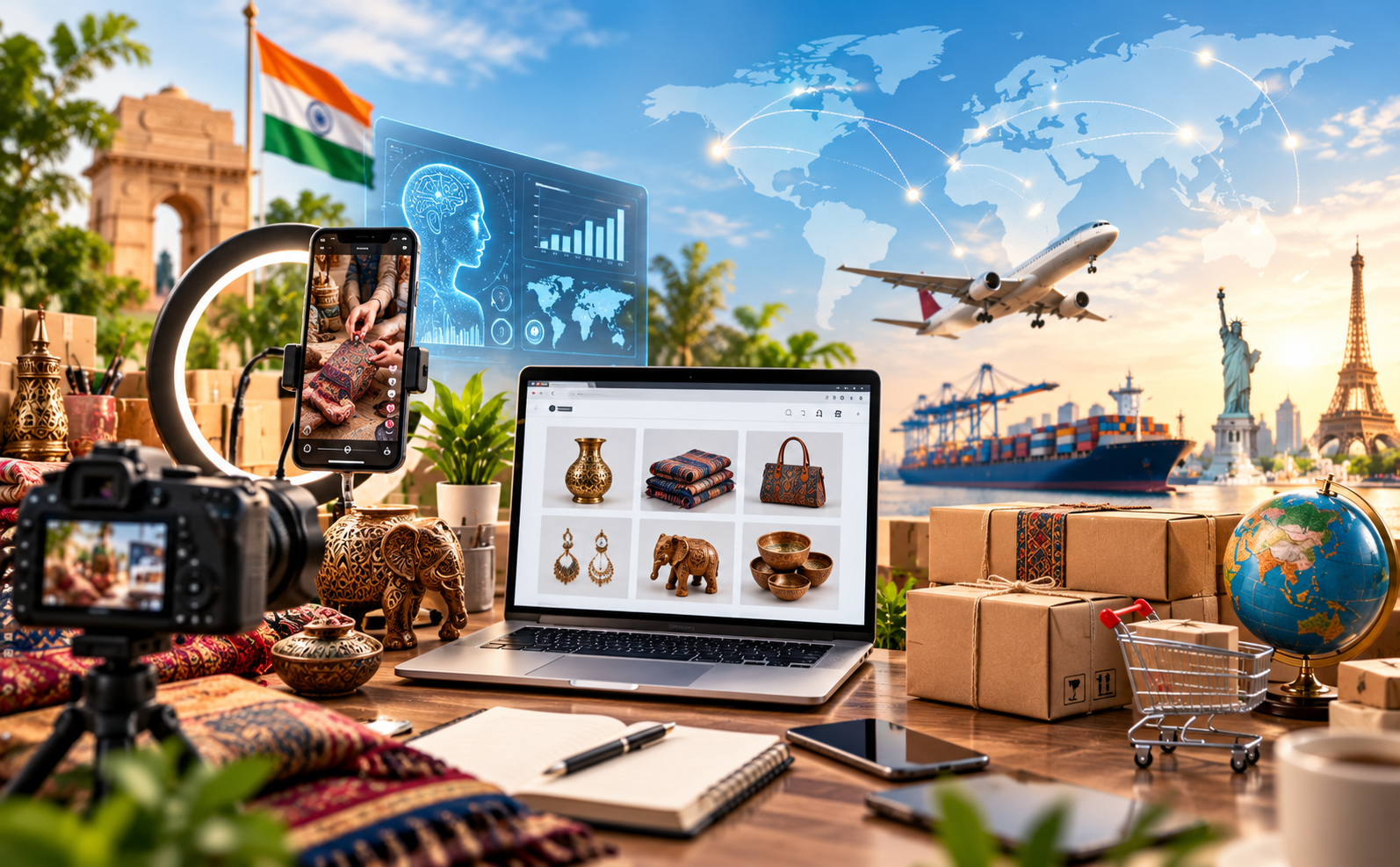
Starting an e-commerce export business from India no longer has to mean building a large inventory, opening an overseas office or waiting years to find international buyers.
Set Up Your E-Commerce Export Business from India
A small Indian business can now combine AI-powered research, social media, short-form video, creator marketing, digital commerce and international postal or courier logistics to test demand in overseas markets.
The smarter approach is to build the business around demand first:
Find the right product → identify the right market → create content → attract attention → generate leads → test orders → ship internationally → learn from customers → scale.
The objective is not simply to collect social-media views. The objective is to turn attention into commercial intent, commercial intent into leads, and leads into international sales.
For new exporters, this creates a potentially leaner way to enter global markets.
1. How an E-Commerce Export Business from India Works
Traditional export businesses often begin with production, inventory, distributors and physical market development.
A digital-first exporter can approach the sequence differently.
Instead of:
Manufacture → Stock → Search for Buyers → Sell
the model can become:
Research → Test Demand → Create Content → Generate Leads → Take Orders → Fulfil → Scale
This does not eliminate the need for export documentation, product compliance, logistics, taxation or proper commercial planning.
It simply changes when you invest and what you learn before investing more.
For an Indian MSME, manufacturer, artisan, trader or emerging brand, the first objective should be to answer three questions:
- Which product should I sell?
- Which market should I target?
- Can I generate genuine customer interest before committing significant capital?
2. Start With One Product and One Market
One of the biggest mistakes new businesses make is trying to sell everything everywhere.
A better starting model is:
One Product + One Target Market + One Customer Segment
For example:
- Indian home textiles → selected Southeast Asian market
- Handcrafted products → diaspora and lifestyle customers
- Specialty food products → a specific international customer segment, subject to applicable regulations
- Fashion accessories → a defined demographic
- Industrial components → a specific B2B market
- Traditional Indian products → customers interested in cultural or heritage products
The product should have a clear reason for being purchased.
Ask:
Why would someone outside India buy this product?
The answer could be:
- design
- craftsmanship
- functionality
- price-value
- material
- cultural identity
- sustainability characteristics
- customisation
- quality
- uniqueness
Do not assume that an Indian product automatically has international demand.
Test the proposition.
3. Use AI Before You Spend Money
AI can dramatically reduce the time required for preliminary research.
A new exporter can use AI tools to help investigate:
- potential countries
- customer segments
- competitors
- product positioning
- market trends
- search behaviour
- content ideas
- product descriptions
- frequently asked questions
- customer objections
- social-media content plans
- translation and localisation
- advertising concepts
Tools such as ChatGPT and Gemini offer research capabilities that can help organise and synthesise information across multiple sources. Google Trends can also be used to explore search interest and compare topics or products.
But there is an important rule:
Use AI to accelerate research, not to replace verification.
AI-generated information should not be treated as proof of a buyer, market size, regulation, tariff, certification requirement or commercial opportunity.
Verify important information through government, customs, trade, logistics and other authoritative sources before making a business decision.
4. Find the Market Before Building the Campaign
Do not begin by asking:
“How can I sell this product internationally?”
Start with:
“Where could this product have a commercially relevant customer base?”
Research:
- search demand
- competitor presence
- retail prices
- local alternatives
- customer reviews
- product positioning
- shipping feasibility
- import requirements
- product restrictions
- payment options
- delivery expectations
- local cultural preferences
A market that looks attractive online may still be difficult to serve commercially.
That is why market research should combine digital demand + commercial feasibility + logistics + regulation.
5. Social Media Can Become Your Global Shop Window
Social media is no longer only a promotional channel.
For a small exporter, it can become an early-stage international market-discovery and demand-generation system.
Platforms such as Instagram, Facebook, YouTube and other relevant social channels can help businesses:
- introduce products
- demonstrate products
- educate customers
- tell the brand story
- show manufacturing
- demonstrate use cases
- build trust
- collect enquiries
- test different markets
- identify which content attracts potential buyers
The objective should not be:
“Get more followers.”
The objective should be:
“Reach the right people and create measurable commercial interest.”
6. Turn One Product Into 30 Pieces of Content
A common mistake is believing that every product needs a separate advertisement.
Instead, build a content system around the product.
For one product, you could create:
Product content
- What is the product?
- What problem does it solve?
- How is it used?
- What makes it different?
- What material is it made from?
Story content
- Why was it created?
- Who makes it?
- Where is it made?
- What is the story behind it?
- What makes it Indian?
Demonstration content
- Product demonstration
- Before-and-after use
- Packaging demonstration
- Quality inspection
- Different ways to use it
Educational content
- Product buying guide
- Common mistakes
- Product comparison
- Care instructions
- Frequently asked questions
Trust content
- Customer review
- Customer testimonial
- Behind-the-scenes production
- Founder story
- Order preparation
Conversion content
- Product launch
- Limited campaign
- Sample request
- International shipping information
- Direct purchase or enquiry CTA
The same product can therefore support a continuous content campaign rather than one advertisement.
7. Video Content Can Create Product Demand
For many products, video is more powerful than simply showing a catalogue photograph.
A potential customer may not understand the value of a product from one image.
A video can demonstrate:
- how it works
- how it looks
- how it is manufactured
- how it is packaged
- how it is used
- why it is different
- what problem it solves
Short-form video can be particularly useful for testing different product messages.
For example, instead of creating ten advertisements for the same product, create ten different stories.
One video may focus on craftsmanship.
Another may focus on functionality.
Another may focus on the Indian origin.
Another may demonstrate the product.
Another may answer a customer question.
The audience response can help reveal which message has the strongest commercial potential.
8. Use AI to Build Your Video Content Engine
AI can help a small business create a structured content system.
For example, an exporter can ask an AI tool to develop:
- 30-day content calendars
- video hooks
- short-video scripts
- product storytelling
- customer FAQs
- video captions
- multilingual content
- product education scripts
- influencer briefs
- advertising variations
AI can also help repurpose one piece of content into multiple formats.
For example:
One product demonstration
can become:
- Instagram Reel
- YouTube Short
- Facebook video
- product-page video
- WhatsApp status
- blog article
- email content
- FAQ
- sales presentation
The important point is not to automate everything.
The business should still provide real product knowledge, real images, real manufacturing information and real customer experiences.
9. Influencer Marketing: From Reach to Demand Generation
Influencer marketing should not be treated simply as:
“Pay someone with many followers to promote my product.”
For export businesses, a better model is creator-led market testing.
Find creators whose audience matches the product and target market.
Then test:
Creator → Content → Audience Reaction → Website Visit → Enquiry → Order
The creator may demonstrate the product, review it, explain its use or introduce the story behind it.
The most important question is not:
“How many people saw the post?”
It is:
“Did the right people take action?”
10. Measure Commercial Intent, Not Just Views
Suppose a video receives 100,000 views.
That sounds impressive.
But what if almost nobody visits the product page or asks about the product?
Now imagine another video receives only 10,000 views but generates:
- 500 website visits
- 100 enquiries
- 20 sample requests
- 10 orders
The second campaign may be commercially more valuable.
Therefore, build a measurement funnel:
Views
↓
Engagement
↓
Profile / Website Visits
↓
Product Interest
↓
Leads
↓
Sample Requests
↓
Orders
↓
Repeat Customers
The objective is to move people progressively down this funnel.
11. Build a Global Lead-Generation System
Not every international customer will immediately place an order.
Especially in B2B exports, a visitor may first want:
- catalogue
- quotation
- sample
- MOQ
- specifications
- certification information
- export price
- distributor information
- customisation options
Your digital system should therefore support different types of conversion.
Possible CTAs include:
Buy Now
Request a Sample
Ask for Export Pricing
Request Product Information
Become a Distributor
Talk to Us
Request a Catalogue
Explore Wholesale Opportunities
This converts social media from a publishing activity into a lead-generation channel.
12. Build the E-Commerce Store Around International Customers
An international product page should answer questions before the customer has to ask them.
Include:
- clear product name
- strong product photographs
- product description
- dimensions
- material
- specifications
- usage
- packaging information
- country of origin
- available variants
- approximate dispatch information
- shipping information
- customer support
- payment information
- return/refund policy where applicable
- relevant compliance information
Do not simply copy an Indian domestic product listing and publish it internationally.
The international customer needs a different level of information.
13. Use AI to Improve the Product Page
AI can help transform basic product information into clearer international content.
For example, provide:
Product name + material + dimensions + use + target customer + unique features
and ask AI to help create:
- product description
- short description
- FAQ
- product benefits
- social captions
- video scripts
- email copy
- customer-service responses
But always verify the final content.
Never allow AI to invent:
- certifications
- product specifications
- country-of-origin claims
- health claims
- environmental claims
- guarantees
- buyer relationships
Accuracy is more important than polished language.
14. Create Demand Before Creating Large Inventory
This is one of the most important ideas in a modern e-commerce export model.
Do not automatically manufacture a large quantity simply because you believe a product will sell internationally.
Instead, conduct a controlled market experiment.
Stage 1 — Research
Select the product and target market.
Stage 2 — Content
Create product photographs and videos.
Stage 3 — Demand
Publish content and test audiences.
Stage 4 — Lead Generation
Measure enquiries and sample requests.
Stage 5 — Trial Orders
Fulfil small orders where commercially and legally appropriate.
Stage 6 — Feedback
Understand:
- why customers purchased
- what they liked
- what they disliked
- whether the price worked
- whether shipping worked
- whether the packaging worked
Stage 7 — Scale
Only after evidence of demand should the business consider increasing inventory or investing in larger market-development activities.
15. India Post Can Be Part of the Small-Order Export Model
For suitable products and destinations, India Post can provide an important international shipping option.
India Post currently lists International Tracked Packet as a service designed for cross-border e-commerce transactions. The general maximum permissible weight is 5 kg, subject to the destination country’s applicable limit, and the service provides tracking. India Post also lists volume discounts and other features subject to its terms.
This can make postal logistics worth investigating for businesses that want to test smaller international shipments rather than immediately moving to large freight arrangements.
However, India Post is not automatically the best option for every product, destination or order size.
Compare:
- postal service
- courier
- freight forwarder
- marketplace fulfilment
- other logistics providers
based on:
cost + weight + destination + delivery expectations + tracking + product restrictions + order volume.
16. Understand the India Post E-Commerce Export Process
The DGFT’s E-Commerce Exports Handbook for MSMEs describes a postal export workflow involving registration with the Department of Posts using the required exporter details, including IEC, GSTIN and the AD Code of the merchant bank; it also describes the use of the Postal Bill of Export for e-commerce exports and shipment induction through a Dak Niryat Kendra or International Business Centre.
Because postal, customs and export procedures can change, exporters should verify the current process and requirements before shipping.
For a new exporter, the practical lesson is simple:
Do not wait until you receive your first international order to understand your logistics process.
Test the shipment process first.
17. Packaging Is Part of the Export Product
International shipping can involve repeated handling and long transit distances.
Packaging therefore has two jobs:
Protect the product
and
Create a professional customer experience.
The DGFT e-commerce export handbook specifically highlights packaging requirements relating to protection, handling, tamper resistance and the nature of the journey.
Before launching internationally, test:
- outer packaging
- inner protection
- moisture protection where relevant
- labels
- invoice/document placement
- product presentation
- package dimensions
- actual shipping weight
A beautiful product damaged during international delivery is still a failed export experience.
18. Calculate the Real Cost Before Setting the Price
A common e-commerce mistake is to calculate:
Product Cost + Profit = Selling Price
International e-commerce requires a broader calculation.
Consider:
Product Cost
Packaging
Domestic movement
International Shipping
Platform / Payment Costs
Marketing / Customer Acquisition Cost
Applicable Taxes or Charges
Returns / Replacement Risk
=
Real Commercial Cost
Only then should you determine the selling price.
A product that looks highly profitable at the factory gate may become uncompetitive after international shipping and customer-acquisition costs.
19. Get Your Export Basics Right
Digital marketing does not remove the underlying export requirements.
Before commercial exports, businesses need to understand the applicable requirements around:
- business structure
- PAN
- GST
- IEC
- bank account
- AD Code
- HS / ITC(HS) classification
- export policy
- product-specific permissions
- destination-market requirements
- customs documentation
The DGFT e-commerce export handbook identifies IEC, GST-related requirements, bank/AD-code information and product-specific regulatory checks as important elements of the export setup. It also notes that export requirements can vary according to the product and its classification.
The correct approach is:
Research the product → identify the HS/ITC(HS) classification → check export policy → check destination requirements → confirm documentation → then sell.
20. Understand GST and Export Treatment
Exports of goods or services are treated as zero-rated supplies under Section 16 of the IGST Act, subject to the applicable conditions and procedures. The framework provides routes including export under a Letter of Undertaking/bond without payment of IGST and refund of eligible unutilised input tax credit, or export on payment of IGST followed by the applicable refund process.
The exact GST treatment and refund procedure should be confirmed for the business’s circumstances with a qualified tax professional and current government guidance.
Do not build a pricing model around assumptions about tax refunds.
21. Use Social Media to Discover Which Market Responds
One of the biggest advantages of digital selling is that the business can learn from audience behaviour.
Suppose you create the same product campaign for:
Market A
and
Market B
The response may reveal differences in:
- views
- engagement
- enquiries
- product-page visits
- sample requests
- conversion
- customer questions
This does not automatically prove that one country is a better export market.
But it gives you a useful signal for further research.
Digital demand data can become an input into market-selection decisions.
22. Turn Customer Questions Into Market Intelligence
Every customer question is data.
If international customers repeatedly ask:
“Do you ship to my country?”
That tells you something about demand.
If they ask:
“Can I buy this in another colour?”
That tells you something about product adaptation.
If they ask:
“Can you supply 100 pieces?”
That may indicate B2B interest.
If they ask:
“Can you provide private labelling?”
That may reveal a completely different business opportunity.
Therefore:
Customer Conversation → Market Intelligence → Product Improvement → Commercial Opportunity
This is where an e-commerce export operation can begin developing into a larger export business.
23. From D2C Sales to B2B Export
A business may begin with small international orders.
But it should remain alert for larger opportunities.
A social-media campaign might eventually attract:
- retailer
- importer
- distributor
- hospitality company
- designer
- corporate buyer
- sourcing agent
- institutional buyer
The business can then move from:
D2C
to
Wholesale
to
Distribution
to
Market Linkage
to
Trade Events
to
Trade Missions
The first international customer does not have to be the final business model.
24. Build a Creator-to-Export System
A scalable model can look like this:
Step 1
Select a product.
Step 2
Select a target market.
Step 3
Research local customer behaviour.
Step 4
Create market-specific content.
Step 5
Identify relevant creators.
Step 6
Provide creators with accurate product information.
Step 7
Test multiple content formats.
Step 8
Track traffic and enquiries.
Step 9
Identify the highest-performing audience segments.
Step 10
Convert demand into orders.
Step 11
Analyse customer feedback.
Step 12
Scale the strongest market and product combination.
This is much more sophisticated than simply “doing influencer marketing.”
25. Your First 30-Day E-Commerce Export Experiment
Days 1–7: Product + Market
Choose:
- one product
- one country
- one customer segment
Research demand, competition, regulations and logistics.
Days 8–14: Content
Prepare:
- product photographs
- 5–10 short videos
- product page
- FAQs
- social-media profiles
- enquiry mechanism
Use AI to accelerate content production.
Days 15–21: Demand Generation
Publish:
- product demonstrations
- educational videos
- product stories
- customer-problem content
- behind-the-scenes content
Test relevant creators where appropriate.
Days 22–30: Conversion
Track:
- reach
- engagement
- website visits
- enquiries
- sample requests
- orders
- shipping cost
- customer questions
At the end of the experiment, make a decision:
Stop → Improve → Continue → Scale
26. The Modern Export Starter Stack
A small business does not need dozens of expensive systems at the beginning.
It needs a connected operating system.
Market Research
AI research tools + Google Trends + official trade sources
Product Content
Camera/phone + AI-assisted copywriting + basic design tools
Demand Generation
Instagram + Facebook + YouTube + relevant social platforms
Video
Short-form product videos + demonstrations + educational content
Influencer Marketing
Relevant creators + sample/product collaboration + trackable campaigns
Lead Generation
Website + enquiry form + WhatsApp Business + email
E-Commerce
Own website and/or suitable marketplace
Logistics
India Post + courier/logistics alternatives
Business Intelligence
Spreadsheet/CRM + analytics + customer feedback
The important thing is not the number of tools.
It is how well the tools connect.
27. What Not to Do
Do not:
- buy huge inventory before testing demand
- target every country simultaneously
- rely only on followers
- judge success only by views
- copy domestic product listings into international markets
- allow AI to invent product information
- ignore shipping costs
- ignore destination-market regulations
- use influencers without measuring results
- promise delivery times you cannot control
- assume every international customer is a profitable customer
- treat every social-media enquiry as a confirmed buyer
Most importantly:
Do not confuse attention with demand.
Demand becomes commercially meaningful when people are willing to take action.
28. The Bigger Opportunity for Indian Businesses
India has thousands of products that can potentially be presented to international customers through digital channels.
The opportunity is not simply to put those products online.
The bigger opportunity is to build a complete system:
Indian Product
↓
Market Research
↓
AI-Assisted Discovery
↓
Social Media
↓
Video
↓
Creator Marketing
↓
Demand Generation
↓
Lead Generation
↓
E-Commerce
↓
International Logistics
↓
Customer Feedback
↓
Market Intelligence
↓
B2B Opportunity
↓
Market Linkage
↓
Trade Events
↓
Trade Missions
↓
Market Expansion
That is the transition from a small online seller to a serious international business.
29. The Exporter of the Future May Start With a Phone
The traditional image of an exporter is a company with a factory, warehouse, office and international sales team.
That model will continue to exist.
But a new generation of Indian exporters can start much smaller.
A smartphone can become a product studio.
AI can become a research assistant.
Social media can become a global shop window.
Creators can become market-entry partners.
An e-commerce website can become a sales channel.
India Post or another suitable logistics provider can become part of the fulfilment system.
Customer conversations can become market intelligence.
And a first international order can become the beginning of a much larger export journey.
The objective is not to remain small.
The objective is to start intelligently, validate demand and scale when the evidence supports it.
30. From E-Commerce to Market Access
E-commerce can be the beginning—not the end—of international business.
A business that discovers strong demand in a particular country can eventually explore:
- local distributors
- importers
- wholesale partnerships
- retail channels
- institutional buyers
- trade events
- sourcing programmes
- business delegations
- market visits
- local partnerships
This is where digital demand generation can connect with a broader market-access strategy.
For Indian businesses, the journey can therefore move from:
Digital Discovery → First Sale → Repeat Sales → B2B Interest → Market Linkage → Physical Market Access
Final Takeaway
Starting an e-commerce export business from India does not have to begin with a large warehouse or a huge international marketing budget.
A smarter approach is to build a demand-led export system.
Use AI to research.
Use social media to discover audiences.
Use video to demonstrate the product.
Use creators to build trust and test markets.
Use digital channels to generate leads.
Use e-commerce to capture orders.
Use suitable postal or courier logistics to fulfil them.
Then study what customers actually do.
The winning formula is not:
More products + more followers + more advertisements.
It is:
Better product + better market + better content + better demand generation + better fulfilment + better learning.
For a new Indian exporter, that can be the foundation of a much larger global business.