


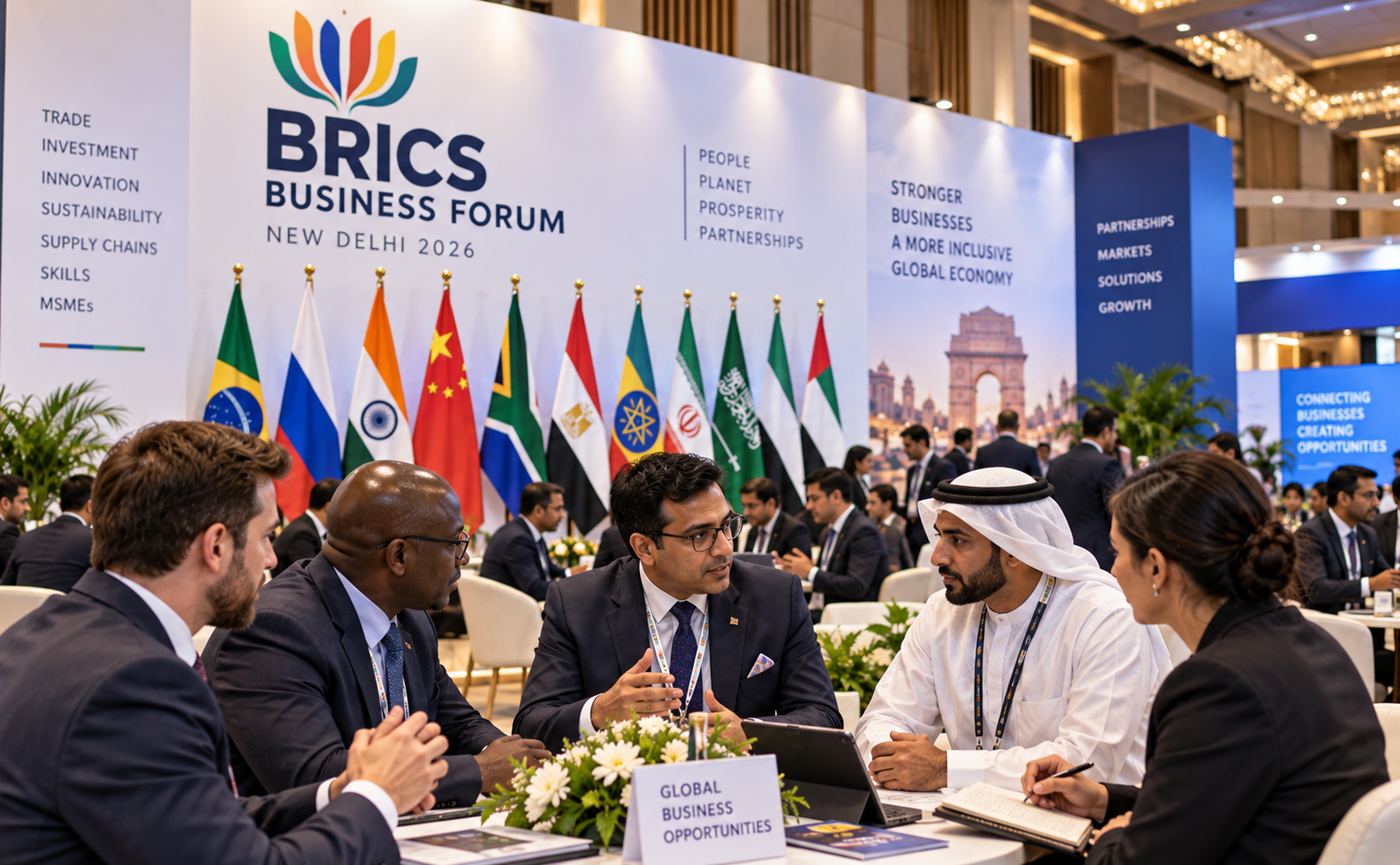
As BRICS Business Forum 2026 leaders meet in New Delhi, India is pushing for deeper intra-BRICS trade, easier market access, stronger supply chains and better cross-border payment connectivity — issues that could directly affect exporters, importers and businesses across the expanded bloc.
The BRICS conversation has moved from the summit room to the business table.
At the BRICS Business Forum in New Delhi on 11 September, India called for deeper and more balanced trade among BRICS members and partner countries, with greater market access, simpler regulatory procedures, stronger supply chains and improved payment connectivity. The discussions come just as leaders gather for the 18th BRICS Summit on 12–13 September.
For businesses, these discussions matter because trade growth ultimately depends on whether companies can enter markets, find partners, move goods and receive payments efficiently.
India Wants BRICS Markets to Open Further
Commerce and Industry Minister Piyush Goyal urged BRICS members and partner countries to open their markets further and simplify regulatory procedures.
He also called for faster clearance of consignments and stronger cooperation across sectors including agriculture, pharmaceuticals, engineering, electronics, automobiles, services, startups and emerging technologies.
For Indian exporters, the message is significant.
A larger BRICS grouping creates a larger potential market, but market size alone does not create exports.
Businesses need:
Market access → buyers → competitive products → regulatory clearance → logistics → payments
The current BRICS discussions are therefore focused on several of the practical barriers that sit between a potential market and an actual trade transaction.
Supply Chains Are Becoming a Central Business Issue
Supply-chain resilience has emerged as one of the strongest commercial themes of the BRICS Business Forum.
External Affairs Minister S. Jaishankar highlighted supply-chain connectivity, trade facilitation and innovation as key priorities. The official BRICS Business Forum programme also placed strengthening trade and supply chains at the centre of its discussions.
This matters for Indian manufacturers and suppliers looking to participate in international production networks.
The opportunity could involve:
- Components
- Engineering products
- Industrial machinery
- Electronics
- Automotive parts
- Agricultural inputs
- Technology
- Logistics
- Business services
For companies, the question is no longer simply “Where can we export?”
It is increasingly:
“Where can we become part of a wider supply chain?”
Payments Could Become a Major Trade Enabler
Cross-border payments are another important issue being discussed within BRICS.
India has called for BRICS members and partners to explore linking payment systems and promoting trade in national currencies. The objective is to make cross-border transactions more efficient while supporting greater commercial connectivity between member economies.
This is particularly relevant to exporters and importers because payment arrangements can influence:
- Transaction costs
- Currency exposure
- Settlement speed
- Trade finance
- Commercial risk
There is significant interest in linking domestic payment systems, although practical challenges remain, including differences between financial systems, currencies, capital controls and trade imbalances.
For businesses, the important distinction will be between policy discussions and payment mechanisms that become practically usable for cross-border trade.
Services Are Part of the Opportunity
The BRICS trade discussion is not limited to physical goods.
India is also seeking greater opportunities for services trade. At the BRICS Business Forum, Goyal emphasised the need for more balanced trade and greater expansion of services commerce.
That opens a wider field for Indian businesses.
Potential areas include:
- IT services
- Digital services
- Professional services
- Technology
- Business services
- Education
- Healthcare
- Financial services
- Creative and knowledge-based industries
For India, this could be particularly important because international market access increasingly involves both products and services.
Agriculture and Startups Enter the Conversation
The BRICS business agenda is also reaching smaller and emerging businesses.
Goyal called for greater cooperation among agri-tech startups to develop solutions for farmers and strengthen food security across BRICS countries.
At the same time, India’s Bharat Innovates Exposition has created a platform for Indian deep-tech startups to engage with international businesses, investors and potential partners during the BRICS programme. The exposition features 37 Indian deep-tech innovators and is designed to support B2B engagement, investment discussions and international market access.
This creates another potential pathway:
Indian Innovation → BRICS Business Connection → Partnership → Investment → International Market
What Indian Exporters Should Watch
The most important question now is whether the discussions taking place around BRICS can translate into practical improvements for businesses.
Indian exporters should watch five areas closely.
1. Market Access
Will BRICS members reduce regulatory and procedural barriers?
2. Supply Chains
Can Indian manufacturers become suppliers to businesses across the expanded BRICS network?
3. Payments
Will payment-system cooperation eventually make cross-border transactions easier?
4. Services
Can Indian service companies gain greater access to BRICS markets?
5. Business Connections
Will summit-level cooperation translate into actual buyer-seller relationships, investments, partnerships and sourcing opportunities?
The Business Opportunity Is Still Country-Specific
BRICS should not be treated as one uniform market.
The requirements of a buyer in China can be very different from those of a buyer in Brazil, Russia, the UAE, Indonesia or South Africa.
Indian businesses therefore need to move from the broad BRICS opportunity to specific questions:
Which country?
Which product?
Which buyer?
Which certification?
Which distribution partner?
Which payment mechanism?
Which supply chain?
That is where the real commercial work begins.
From Summit Discussions to Business Opportunities
The BRICS Business Forum demonstrates an important shift in the way international economic cooperation is being discussed.
The focus is increasingly moving toward practical issues:
OPEN MARKETS
SIMPLER PROCEDURES
RESILIENT SUPPLY CHAINS
BETTER PAYMENTS
BUSINESS CONNECTIONS
If these priorities translate into concrete mechanisms, they could make it easier for companies across BRICS economies to trade and collaborate.
But the real test will come after the summit — when businesses begin asking whether these commitments can help them find customers, suppliers, partners and markets.
The Exim Times Perspective
A summit can create the framework.
A business relationship creates the transaction.
For Indian exporters and businesses, the next phase of BRICS will therefore be worth watching not only for diplomatic announcements, but for the commercial opportunities that emerge from them.
As the 2026 BRICS Summit unfolds in New Delhi, The Exim Times will track the developments that matter to trade, markets and businesses.