



By The Exim Times | International Trade Desk
India has achieved a major milestone in its international trade journey with the signing of the India–United Kingdom Comprehensive Economic and Trade Agreement (CETA). Signed in the presence of Prime Minister Shri Narendra Modi and UK Prime Minister Sir Keir Starmer, the agreement marks one of India’s most significant Free Trade Agreements with a developed economy and is expected to transform bilateral trade, investment, services, and professional mobility.
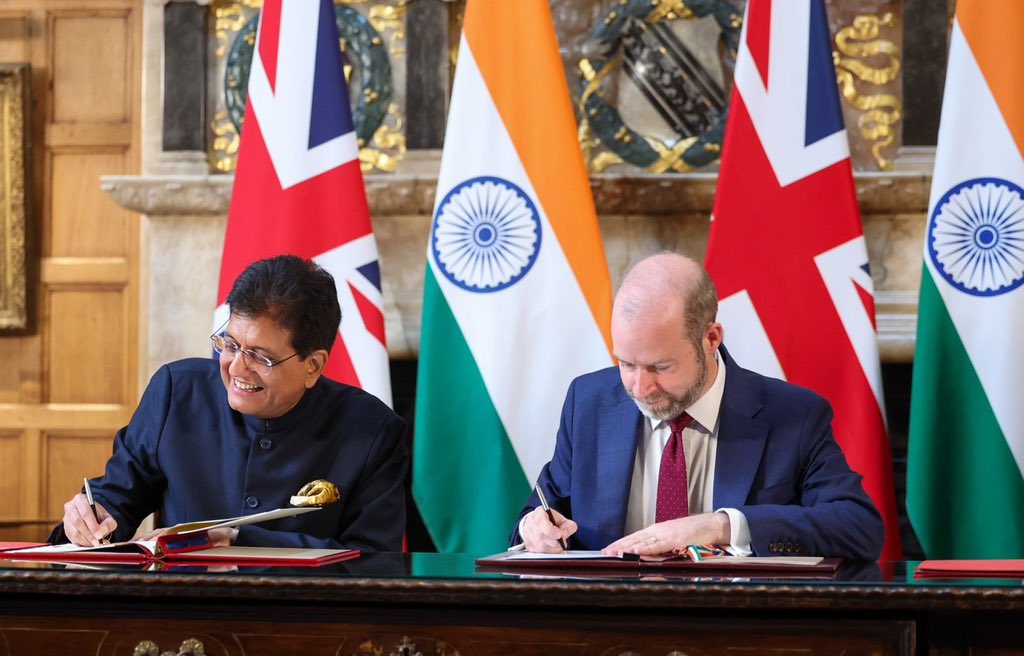
The agreement was formally signed by Union Commerce and Industry Minister Shri Piyush Goyal and UK Secretary of State for Business and Trade Jonathan Reynolds, reflecting the commitment of both nations to deepen economic cooperation and strengthen long-term strategic ties.
Historic Market Access for Indian Exporters
One of the most significant achievements under CETA is the zero-duty access on 99% of tariff lines, covering nearly the entire value of India’s exports to the UK. This unprecedented market access is expected to substantially improve the competitiveness of Indian products and create fresh export opportunities across multiple sectors.
Labour-intensive industries such as:
- Textiles and Apparel
- Leather and Footwear
- Gems & Jewellery
- Marine Products
- Toys and Sports Goods
are expected to witness strong export growth. Engineering goods, auto components and organic chemicals are also among the sectors likely to benefit from improved market access.
Strong Boost for India’s Services Sector
The agreement extends beyond merchandise trade by offering expanded access for India’s globally competitive services industry. IT and IT-enabled services, financial services, legal and professional services, education, architecture, engineering, consulting and digital trade are expected to gain from improved market access in the UK.
Greater Mobility for Indian Professionals
CETA introduces simplified mobility provisions for Indian professionals, including:
- Contractual Service Suppliers
- Business Visitors
- Intra-Corporate Transferees
- Independent Professionals such as architects, engineers, yoga instructors, chefs and musicians
These provisions are expected to facilitate smoother cross-border movement of skilled professionals while enhancing collaboration between Indian and British businesses.
Double Contribution Convention: A Landmark Relief
Among the most impactful features of the agreement is the Double Contribution Convention (DCC). Under this arrangement, Indian professionals working temporarily in the UK and their employers will be exempt from UK social security contributions for up to three years.
This measure is expected to increase take-home income for Indian employees while reducing employment costs for Indian companies operating in the UK market.
Bilateral Trade Target to Double by 2030
India and the United Kingdom currently enjoy bilateral trade valued at approximately USD 56 billion. Through CETA, both countries have set an ambitious objective of doubling bilateral trade by 2030 by promoting greater trade, investment and economic integration.
Inclusive Growth Across the Economy
The agreement has been designed to ensure that the benefits extend beyond large corporations. MSMEs, startups, women entrepreneurs, farmers, fishermen, artisans and innovators are expected to gain better integration into global value chains through reduced trade barriers and improved market opportunities.
The Exim Times Analysis
The India–UK CETA represents far more than a conventional free trade agreement. It establishes a comprehensive framework covering goods, services, investment, professional mobility and long-term economic cooperation.
For Indian exporters, particularly MSMEs, the agreement creates significant opportunities to expand exports into one of the world’s leading consumer markets. Businesses should now focus on strengthening product quality, compliance with UK standards, branding and supply chain capabilities to fully capitalize on the preferential market access offered under the agreement.
As India accelerates its vision of becoming a global manufacturing and export powerhouse, the India–UK CETA is expected to serve as a catalyst for higher exports, increased employment, stronger international partnerships and sustained economic growth.
The Exim Times will continue to provide sector-wise analysis, export opportunities and practical guidance to help Indian businesses leverage the full potential of this landmark agreement.