
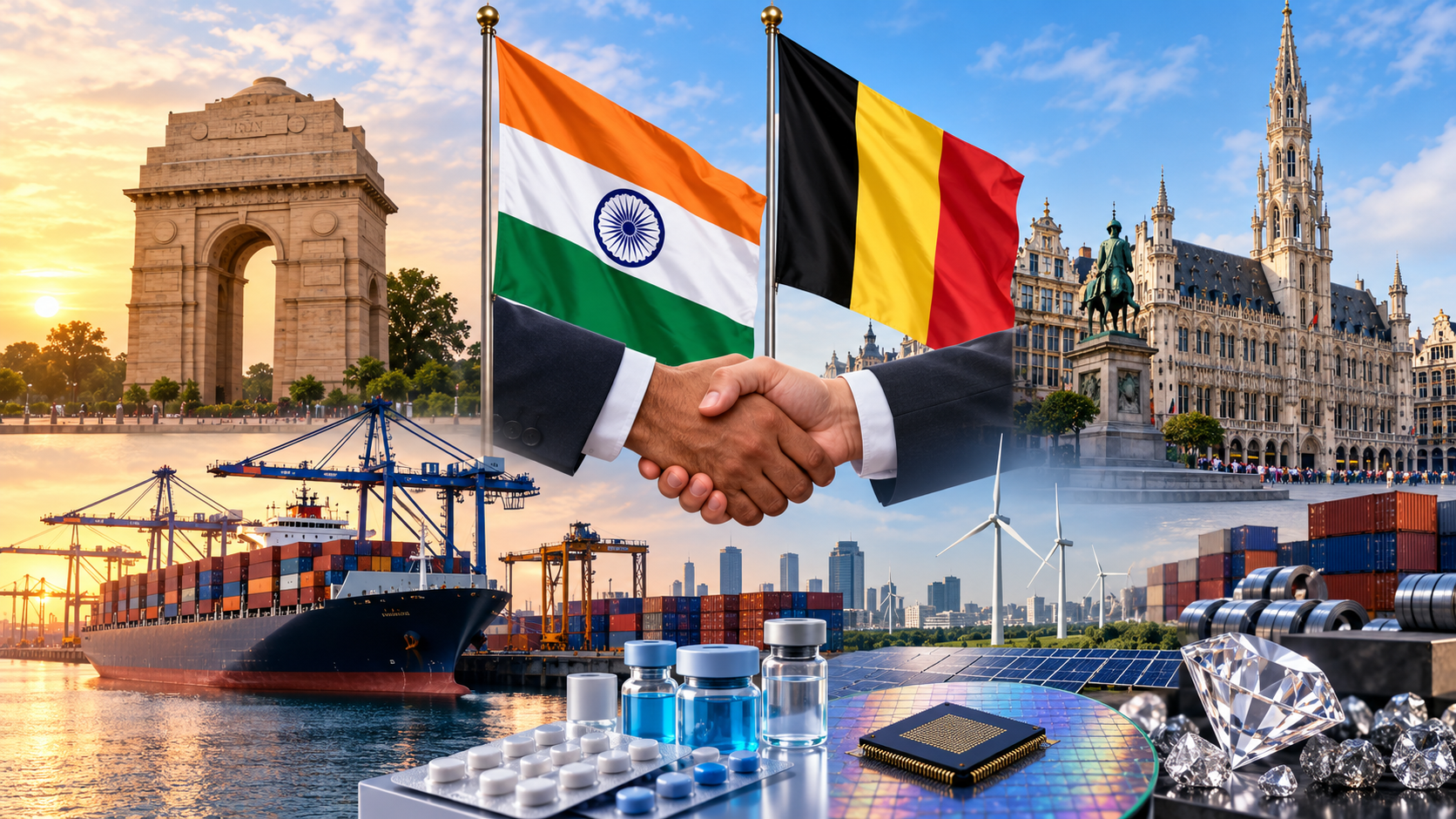
India and Belgium are expanding their economic partnership across trade, investment, pharmaceuticals, logistics, advanced manufacturing and technology, with both sides targeting a doubling of bilateral trade over the next five years.
KEY TAKEAWAY
India Belgium trade is entering a broader phase as both countries target doubling bilateral trade over the next five years., while broadening the relationship beyond its traditional strengths in diamonds and precious metals.
The new agenda covers pharmaceuticals and life sciences, semiconductors, clean energy, critical minerals, ports and logistics, defence, aerospace, advanced manufacturing, digital technologies and investment.
The objective is not simply to increase the value of goods traded between the two countries. The broader strategy is to create more investment, technology partnerships, resilient supply chains and business-to-business opportunities.
India and Belgium Set a Five-Year Trade Ambition
India and Belgium have agreed to work towards doubling bilateral trade over the next five years, giving the economic relationship a more ambitious direction.
The goal was highlighted during Belgian Prime Minister Bart De Wever’s visit to India from 2–4 September 2026 and was included in the India–Belgium Joint Statement issued on 3 September.
The target should be viewed as an ambition rather than a guaranteed outcome. Achieving it will depend on the ability of companies in both countries to convert government-level agreements into investment, contracts, supply-chain partnerships and actual trade flows.
That makes the next phase particularly relevant for exporters, investors and businesses looking for European market opportunities.
India Belgium Trade Has a Strong Base — But Also a Recent Decline
India and Belgium already have a significant commercial relationship.
The Department of Commerce Trade Intelligence and Analytics portal currently displays India’s FY2025-26 exports to Belgium at approximately US$6.60 billion and imports at approximately US$6.41 billion, putting total bilateral merchandise trade at about US$13.01 billion.
Historical DGCIS data shows that bilateral trade has fluctuated considerably over recent years. Total trade reached around US$20 billion in 2021-22 before declining to approximately US$13.2 billion in 2024-25.
This makes the five-year doubling objective more significant. The challenge is not merely to recover previous trade levels but to create new sources of commercial growth.
From Diamonds to a More Diversified Trade Relationship
Diamonds and precious metals remain an important part of the India–Belgium commercial connection, particularly through the longstanding Antwerp–Mumbai–Surat business corridor.
But the new bilateral agenda is considerably broader.
Major Indian export categories already include:
- Precious metals and stones
- Chemicals
- Base metals
- Drug formulations and biological products
- Iron and steel
- Marine products
India also imports significant quantities of precious metals and stones, chemicals, machinery and equipment from Belgium.
The opportunity now is to build a more diversified relationship in which traditional trade continues while newer sectors generate additional value.
Investment Fast-Track Mechanism Opens a New Channel
India and Belgium have launched an India–Belgium Investment Fast-Track Mechanism to facilitate investment flows between the two countries.
The mechanism is intended to help address investment-related bottlenecks and make it easier for businesses to navigate issues that can delay projects.
For companies considering investment in India or Belgium, such institutional mechanisms can be important because the commercial opportunity is often only the first step.
Regulatory coordination, project approvals, market entry, financing and government-to-business engagement can determine whether an investment opportunity becomes an actual project.
SFPIM and NIIF Could Help Build an Indo-Belgian Investment Corridor
Belgium’s Federal Holding and Investment Company, SFPIM, and India’s National Investment and Infrastructure Fund (NIIF) are cooperating with the objective of strengthening investment connectivity between the two countries.
The cooperation could help establish an Indo-Belgian economic and investment corridor, particularly by connecting institutional investors and businesses with opportunities in both markets.
Cooperation between Belgium’s BIO Invest and NIIF is also being explored.
This creates a potentially important second layer to the bilateral relationship: moving from ordinary trade in goods and services toward cross-border capital, infrastructure and industrial investment.
Belgium Already Has an Investment Footprint in India
Belgian companies have already invested in India across multiple sectors.
DPIIT data on foreign direct investment equity inflows from April 2000 to December 2025 puts Belgium’s cumulative investment at approximately US$4.20 billion, representing about 0.54% of India’s total FDI equity inflows during the period.
The new bilateral agenda could therefore build on an existing investment base rather than starting from zero.
For Indian businesses, Belgian investment can also bring technology, European market connections, engineering expertise and access to international supply chains.
Pharmaceuticals and Life Sciences Offer High-Value Opportunities
Pharmaceuticals and life sciences are among the sectors identified as priorities in the new India–Belgium economic agenda.
India already has a substantial pharmaceutical manufacturing and export base, while Belgium has significant capabilities across life sciences and healthcare.
The opportunity extends beyond conventional pharmaceutical trade.
Potential areas include:
- Pharmaceutical manufacturing
- Healthcare
- Life-science research
- Medical technologies
- Advanced manufacturing
- Research and technology partnerships
For Indian exporters, the opportunity will still depend on meeting European regulatory, quality and product requirements.
Semiconductors Bring the Relationship Into Strategic Technology
Semiconductors are another important addition to the bilateral agenda.
India and Belgium have identified opportunities to connect Belgium’s IMEC ecosystem with India’s expanding semiconductor ecosystem.
The combination could create opportunities where Indian manufacturing scale and market demand are complemented by Belgian expertise in advanced semiconductor research and technology.
This is strategically different from traditional merchandise trade.
Instead of simply exporting a finished product, cooperation in areas such as semiconductors can involve research, technology, investment, manufacturing and supply-chain development.
Clean Energy and Critical Minerals Expand the Supply-Chain Agenda
The bilateral partnership also covers renewable energy and emerging clean-technology opportunities.
Areas identified for cooperation include:
- Green hydrogen
- Solar energy
- Energy storage
- Offshore wind
- Bio-energy
- Small hydro
- Pumped storage
- Critical-mineral processing and recycling
These areas matter because the global energy transition is creating new demand for technology, infrastructure, raw materials and specialised industrial capabilities.
For Indian and Belgian businesses, cooperation could therefore develop around both technology and supply-chain resilience.
Kakinada Shows How the Relationship Can Move Into Projects
The India–Belgium relationship is also moving toward project-level cooperation.
Prime Minister Narendra Modi highlighted a major green ammonia project in Kakinada, Andhra Pradesh, involving Belgian expertise.
The example illustrates the potential direction of the relationship: government agreements can create the framework, but the economic impact ultimately comes through actual projects, investment and industrial activity.
This project-based approach could become increasingly important as both countries pursue clean-energy and advanced-manufacturing opportunities.
Ports and Logistics Could Strengthen the India–Europe Trade Corridor
Logistics, transport and ports are another strategic area of cooperation.
Belgium has substantial expertise connected with European logistics and port infrastructure, while India is expanding its own logistics and port capacity as it seeks to strengthen its position in global supply chains.
The two sides have identified opportunities covering port development, logistics, connectivity, dredging and related capabilities.
Cooperation between the Antwerp/Flanders Port Training Centre and the Jawaharlal Nehru Port Authority for training and capacity building has also been highlighted.
For exporters, better logistics cooperation could eventually support more efficient movement of goods between India and European markets.
Defence and Aerospace Add a New Industrial Dimension
Defence and aerospace are also becoming part of the broader commercial relationship.
India and Belgium have identified opportunities for co-development, co-production and defence industrial partnerships.
A Defence CEOs Roundtable and business-to-business meetings held during the Belgian Prime Minister’s visit provided another channel for companies to explore industrial cooperation.
The significance goes beyond defence procurement. Joint development and manufacturing can potentially create longer-term industrial partnerships involving technology, engineering and specialised supply chains.
Startups and Digital Technology Create Space for New Businesses
The relationship is also expanding into startups and digital technology.
Cooperation involving the MeitY Startup Hub and Hub.Brussels can create opportunities for startups, incubation, digital skills and innovation partnerships.
This is particularly relevant because technology-driven trade does not always follow the traditional exporter-importer model.
Indian technology companies, Belgian startups, investors and innovation institutions can potentially collaborate through partnerships, investment and market expansion.
India–EU FTA Could Expand the Opportunity
Another important factor is the India–European Union trade relationship.
India and the EU successfully concluded negotiations for their FTA at the India–EU Summit in January 2026, and the India–Belgium Joint Statement supports timely implementation.
However, the India–EU FTA should not be described as already in force.
Once implemented, the agreement could create an additional market-access framework for Indian and Belgian businesses operating within the wider EU commercial environment.
For exporters, this makes developments in both bilateral India–Belgium cooperation and the India–EU trade framework worth watching closely.
What Indian Exporters Should Watch
Indian companies looking at Belgium should not view the market simply as another destination for merchandise exports.
The emerging opportunity includes:
- Pharmaceuticals and life sciences
- Engineering and advanced manufacturing
- Clean-energy technologies
- Critical-mineral processing and recycling
- Digital technology
- Semiconductor-related activities
- Defence and aerospace
- Port and logistics services
- Chemicals and specialised materials
- Investment and European supply-chain partnerships
Companies should also evaluate Belgian and EU regulatory requirements, product standards, certification, sustainability expectations and buyer requirements before entering the market.
What Belgian Companies Could Find in India
The opportunity also works in the opposite direction.
Belgian companies can potentially use India as a manufacturing, investment and market platform across sectors such as:
- Advanced engineering
- Pharmaceuticals
- Renewable energy
- Infrastructure
- Logistics
- Defence
- Aerospace
- Semiconductors
- Digital technology
- Chemicals
- Advanced materials
India’s domestic market, manufacturing capabilities and expanding export ecosystem can provide a broader commercial base for Belgian companies looking beyond traditional European markets.
The Challenge Is Turning Agreements Into Trade
The India–Belgium relationship now has many elements of a modern economic partnership.
But announcements alone will not double bilateral trade.
The real test will be whether companies begin signing more contracts, investing in new projects, creating joint ventures, integrating supply chains and entering new markets.
That requires practical follow-through on investment facilitation, customs and logistics, standards, financing, technology partnerships and business matchmaking.
A New India–Belgium Economic Architecture
The emerging relationship is increasingly built around multiple pillars:
Trade → Investment → Technology → Manufacturing → Energy → Logistics → Supply Chains → Innovation
This is a significant evolution from a relationship historically associated strongly with diamonds and precious metals.
The objective is to create a broader economic architecture in which businesses from both countries participate across several sectors.
The Next Five Years Will Test the Strategy
India and Belgium have established a clear ambition: double bilateral trade within five years.
The opportunity is substantial, but achieving it will require commercial execution.
For Indian exporters, Belgium could become more important as a gateway to European customers, investors, technology partners and specialised supply chains.
For Belgian companies, India offers a large market and an expanding manufacturing and investment ecosystem.
The next phase will therefore be measured not by the number of agreements announced, but by how many of those agreements become factories, investments, exports, partnerships and long-term business relationships.
What to Watch Next
The Exim Times will watch for:
- Growth in India–Belgium merchandise trade
- New Belgian investments in India
- Indian investment in Belgium
- Pharmaceutical and life-sciences partnerships
- Semiconductor cooperation involving IMEC
- Green-energy and green-ammonia projects
- Critical-mineral cooperation
- Port and logistics partnerships
- Defence and aerospace industrial agreements
- Startup and technology partnerships
- Implementation of the India–EU FTA
SOURCE
Primary Source: Ministry of Commerce & Industry / Press Information Bureau, Government of India — India–Belgium Joint Statement, 3 September 2026.
PIB — India–Belgium Joint Statement
Additional official sources:
Prime Minister’s Press Statement on India–Belgium Relations
Department of Commerce — Trade Intelligence and Analytics
DGCIS — India–Belgium Trade Profile
DPIIT — FDI Country-wise Data
PIB — India–Belgium Defence CEOs Roundtable