

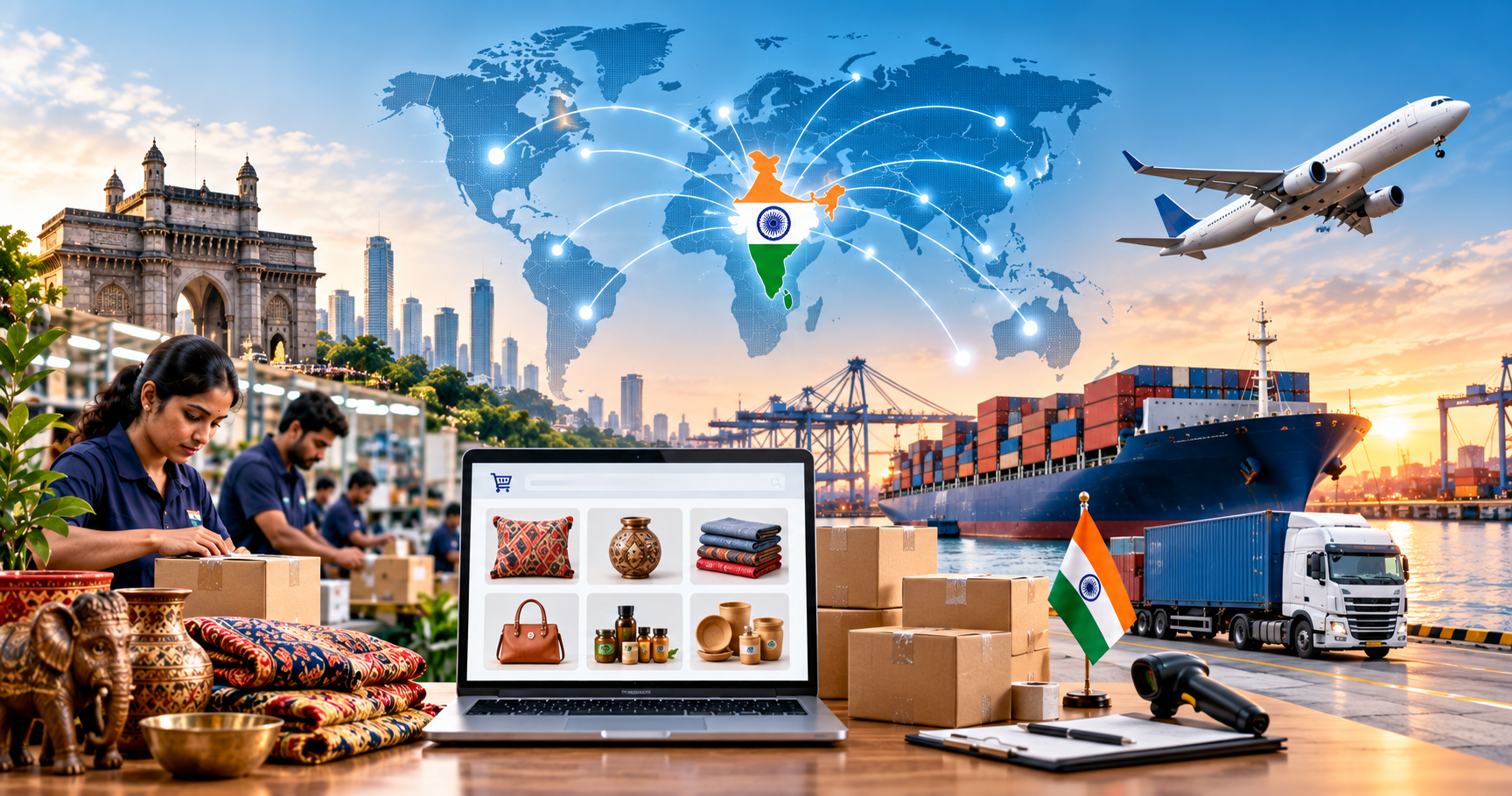
A new DGFT framework allows eligible e-commerce entities to undertake export-only inventory operations through registered Exporters-on-Record, creating a structured route for Indian manufacturers and MSMEs to reach global customers.
KEY TAKEAWAY
Inventory-based e-commerce exports are entering a new phase in India after the Government operationalised an export-only framework under the Foreign Trade Policy.
The framework was operationalised by DGFT on 5 August 2026 through Notification No. 27/2026-27 and Public Notice No. 25/2026-27. It provides a structured mechanism for eligible e-commerce entities to undertake inventory-based cross-border exports of goods manufactured or produced in India.
Under the model, registered Exporters-on-Record (EORs) can procure goods from Indian Sellers-on-Record (SORs) against confirmed overseas orders, export the goods in their own name and undertake specified export and destination-market compliance responsibilities.
The development is significant for Indian manufacturers and MSMEs because it could create an organised export infrastructure layer connecting domestic production with international e-commerce demand.
India Creates an Export-Only Inventory Route
India’s e-commerce policy has traditionally distinguished between marketplace-based operations and inventory-based operations.
A major change came with DPIIT Press Note No. 3 (2026 Series), dated 23 July 2026, which created an export-oriented exception for inventory-based e-commerce involving goods manufactured or produced in India.
DGFT subsequently operationalised the framework under the Foreign Trade Policy 2023.
The distinction is important.
The Government has not generally opened inventory-based e-commerce for domestic B2C operations. The new framework is specifically concerned with export operations.
For Indian businesses, the policy therefore creates a new route through which e-commerce can become an export channel rather than simply a domestic retail mechanism.
How Inventory-Based E-Commerce Exports Change the Operating Model
The central feature of the framework is the Exporter-on-Record.
The EOR acts as the export-side operating entity and procures goods from Indian Sellers-on-Record against confirmed overseas orders.
The relationship can be understood conceptually as:
Indian Manufacturer / Seller
↓
Seller-on-Record (SOR)
↓
Exporter-on-Record (EOR)
↓
International Customer
The EOR exports the goods in its own name and takes responsibility for the applicable export operations.
This separation can allow Indian manufacturers and smaller sellers to concentrate on production while an organised export entity manages international fulfilment and compliance functions.
The precise legal and commercial relationship will depend on the applicable framework and the arrangements between the parties.
Export Compliance Can Be Centralised
Cross-border e-commerce involves considerably more than taking an online order.
Exporters may have to manage documentation, customs, destination-market requirements, testing, certification, packaging, labelling, fulfilment and logistics.
The new framework allows these functions to be handled through the EOR structure.
This could be particularly useful for MSMEs that have exportable products but do not have their own international logistics, compliance or fulfilment infrastructure.
The important point is that compliance is centralised, not eliminated.
The EOR assumes the relevant responsibilities under the framework, while the underlying product must still meet applicable Indian and destination-country requirements.
Confirmed Orders Remain the Key Safeguard
One of the most important safeguards in the framework concerns inventory.
Export inventory must be procured against confirmed export orders.
The framework does not permit speculative inventory build-up for export purposes.
This creates a fundamentally different model from simply purchasing large quantities of goods and waiting for foreign demand to emerge.
The operating principle is closer to:
Confirmed overseas order → procurement → export inventory → fulfilment
This requirement provides a connection between actual international demand and the inventory being held for export.
For businesses, it also means inventory planning under this framework needs to be closely linked to genuine overseas orders.
Inventory Must Remain Traceable
The Government has also built traceability requirements into the model.
Export inventory must be:
- distinctly identified;
- segregated;
- maintained through a digital repository; and
- traceable through relevant export documentation.
The inventory cannot simply be diverted for domestic sale under the framework.
This creates a clear regulatory distinction between goods held for the export operation and goods intended for India’s domestic market.
Digital inventory records therefore become part of the compliance infrastructure supporting the model.
Indian Sellers Get Greater Visibility
The framework also addresses the information relationship between the EOR and Indian sellers.
Sellers are provided visibility regarding matters including:
- final sale price;
- order status; and
- shipment tracking.
For MSMEs, this information can have value beyond an individual transaction.
Understanding final pricing, customer orders and shipment performance can help manufacturers assess which products have international demand and which markets may offer repeat opportunities.
The model therefore has the potential to provide Indian sellers with both an export channel and useful commercial information.
Payment Protection Could Matter to MSMEs
Working capital remains an important issue for smaller businesses entering international trade.
Under the framework, Indian sellers are to receive payment within the prescribed timeline, irrespective of whether the EOR has already received payment from the overseas buyer.
This can reduce the extent to which an Indian seller is exposed to the overseas customer’s payment cycle.
For an MSME, predictable payment can be an important consideration when deciding whether to participate in an international e-commerce supply chain.
The exact payment arrangements remain subject to the prescribed framework and commercial terms between the parties.
Export Benefits Must Flow to Sellers
The framework also provides for the treatment of export rebates and refunds.
Where applicable, these benefits are to be apportioned and passed through to Sellers-on-Record in proportion to the FOB value attributable to their goods.
This is significant because the EOR structure is not designed simply to separate the Indian seller from the economic benefits associated with its export activity.
The mechanism provides for eligible benefits to reach the underlying sellers according to the prescribed calculation.
Returns Are Built Into the Framework
Returns and rejected shipments are unavoidable issues in international e-commerce.
The framework provides procedures for handling returned and rejected consignments.
Depending on the applicable circumstances, goods may need to be:
- re-exported;
- returned to the seller; or
- disposed of according to prescribed procedures.
The framework also prevents export inventory from being casually diverted into India’s domestic market.
For a scalable e-commerce export model, having a defined approach to returns is important because international reverse logistics can otherwise become a major operational and compliance challenge.
What Does This Mean for Indian MSMEs?
The strongest potential impact of the new framework may be on MSMEs.
Many Indian businesses can manufacture competitive products but may lack one or more of the capabilities required to sell internationally:
- Export documentation
- Customs knowledge
- International logistics
- Destination-market compliance
- Product testing and certification
- International packaging and labelling
- Fulfilment
- Returns management
- Overseas customer acquisition
The Government expects the framework to facilitate greater participation by Indian manufacturers, traders and MSMEs in global e-commerce supply chains.
That makes the EOR model potentially important as an export infrastructure layer between Indian production and overseas consumers.
For businesses already exploring the broader district-level export ecosystem, this model also provides another possible route from local production to international customers. Districts as Export Hubs can be particularly relevant when considering how local manufacturers and MSMEs can become export-ready.
E-Commerce Export Finance Is a Separate Policy Support
Alongside the inventory-based export framework, the Government is also using a separate Export Promotion Mission intervention to improve working-capital access for eligible MSMEs engaged in e-commerce exports.
The Credit Assistance for E-Commerce Exporters intervention is being operationalised through Exim Bank.
Under the notified framework, two facilities include:
| Facility | Credit Limit | Guarantee Cover | Maximum Period |
|---|---|---|---|
| Direct E-Commerce Credit Facility | ₹50 lakh | Up to 90% | Up to 365 days |
| Overseas Inventory E-Commerce Credit Facility | ₹5 crore | Up to 75% | Up to 365 days |
The framework also provides for 2.75% upfront interest subvention on eligible financing, subject to the scheme’s conditions.
This financing intervention should be understood separately from the EOR inventory framework.
The distinction matters because the new EOR framework requires export inventory to be linked to confirmed export orders, while the separate credit intervention addresses working-capital requirements for eligible e-commerce exporters under its own rules.
This combination of export infrastructure and finance could become important for MSMEs trying to scale beyond individual international orders.
India’s E-Commerce Export Infrastructure Is Expanding
The inventory-based framework is also part of a broader effort to develop India’s cross-border e-commerce ecosystem.
In 2026, the Government introduced other measures affecting e-commerce exports, including changes to courier-export procedures and the handling of returned and rejected shipments.
The Government has also been developing E-Commerce Export Hubs intended to provide integrated support involving logistics, customs, certification, packaging and warehousing.
These initiatives point toward a broader strategy.
India is not simply trying to encourage businesses to sell products online.
It is attempting to build infrastructure around the complete journey:
Indian production → digital demand → export documentation → fulfilment → logistics → international customer
The inventory-based EOR model adds another layer to that ecosystem.
The New Model Does Not Mean “No Compliance”
The biggest misunderstanding would be to treat the new framework as a way to remove export compliance.
It does not.
The EOR assumes substantial operational responsibilities, including applicable destination-country compliance, testing, certification, packaging, labelling, fulfilment and logistics.
The framework also provides for digital records, inventory traceability and annual compliance certification.
For businesses, the better description is:
Centralised export compliance — not zero compliance.
This distinction will become increasingly important as more companies explore the model.
What the Model Does Not Permit
The export-only character of the framework needs to remain clear.
It does not mean:
- foreign-invested e-commerce entities can freely use the model for domestic inventory-based B2C sales;
- companies can build speculative export inventory without confirmed orders;
- destination-country regulations can be ignored;
- export inventory can simply be diverted into India’s domestic market;
- every e-commerce business automatically qualifies; or
- every MSME automatically receives export finance.
The framework operates within specific eligibility, registration, inventory, documentation and compliance conditions.
Businesses should therefore assess the applicable DGFT and FDI requirements before adopting the model.
From Marketplace to Export Infrastructure
The most important long-term implication may be the potential evolution from a conventional marketplace model toward an integrated export infrastructure model.
A marketplace primarily connects buyers and sellers.
An export-oriented inventory structure can potentially combine:
Manufacturing + inventory + compliance + fulfilment + logistics + finance + international demand
That changes the role of the e-commerce operator.
Instead of simply providing a digital storefront, the export entity can become part of the operational infrastructure through which Indian products reach international customers.
For smaller manufacturers, that could reduce the need to build every element of an export operation independently.
What Indian Businesses Should Watch
The commercial success of the framework will depend on how efficiently it works in practice.
Businesses should monitor:
- EOR registration and operating requirements
- EOR–SOR commercial arrangements
- Destination-country compliance responsibilities
- Inventory segregation and digital traceability
- Treatment of returns and rejected shipments
- Payment timelines for Indian sellers
- Pass-through of eligible export benefits
- Availability of working-capital finance
- Growth of international fulfilment networks
- Actual participation of MSMEs and smaller manufacturers
Businesses also need to understand how the new framework interacts with the wider export ecosystem, including FTA utilisation, market access and destination-country requirements.
The Opportunity Is Bigger Than E-Commerce
The new framework could eventually be relevant to a broad range of Indian businesses with internationally marketable products.
Manufacturers, artisans, specialised product makers and MSMEs could potentially use organised export infrastructure to reach foreign customers through digital channels.
For these businesses, the fundamental question changes from:
“Can I sell my product online?”
to:
“Can I build a repeatable export system around my online demand?”
The policy framework is designed to make that second question easier to address.
But successful international e-commerce will still depend on product quality, pricing, customer service, compliance, logistics and the ability to build repeat demand.
What This Means for India’s Export Strategy
India has been seeking to broaden its exporter base and bring more MSMEs into international trade.
E-commerce provides one route because it can connect smaller producers directly with foreign consumer demand.
But digital demand alone does not create an export business.
Products still have to be manufactured, documented, packaged, cleared, transported, delivered and, where necessary, returned.
The inventory-based EOR framework addresses several of those operational requirements through a structured export entity.
Combined with export finance, courier reforms and E-Commerce Export Hubs, the direction is becoming clearer:
India is building an export ecosystem around digital commerce, not simply promoting online selling.
This could complement the Government’s wider effort to bring more businesses into international trade and diversify India’s exporter base.
The Next Test Is Execution
The regulatory framework is now in place.
The next question is whether businesses can use it efficiently at scale.
For MSMEs, the value will ultimately be measured through actual international orders, predictable payments, manageable compliance costs, efficient fulfilment and repeat export sales.
For e-commerce companies and export-service providers, the opportunity may lie in building the infrastructure that makes those outcomes possible.
And for Indian manufacturers, the new model could provide another pathway from local production to global customers.
That makes inventory-based e-commerce exports an important development to watch as India’s digital export ecosystem evolves.
What to Watch Next
The next phase will be implementation.
The key indicators will be the number of businesses using the EOR structure, the participation of MSMEs, the development of fulfilment networks and the extent to which the framework translates into actual cross-border orders.
The development of export finance, logistics infrastructure and market-access support will also determine whether the model becomes commercially useful beyond the largest e-commerce operators.
If these pieces work together, India’s e-commerce export model could become an important additional route for taking Indian products to international consumers.
SOURCE
Ministry of Commerce & Industry / Press Information Bureau, Government of India
Official PIB — Inventory-based Cross-border E-Commerce Export Framework
Supporting official source: Exim Bank — Credit Assistance for E-Commerce Exporters.
Exim Bank — Credit Assistance for E-Commerce Exporters
FDI policy reference: DPIIT Press Note No. 3 (2026 Series), dated 23 July 2026.


