

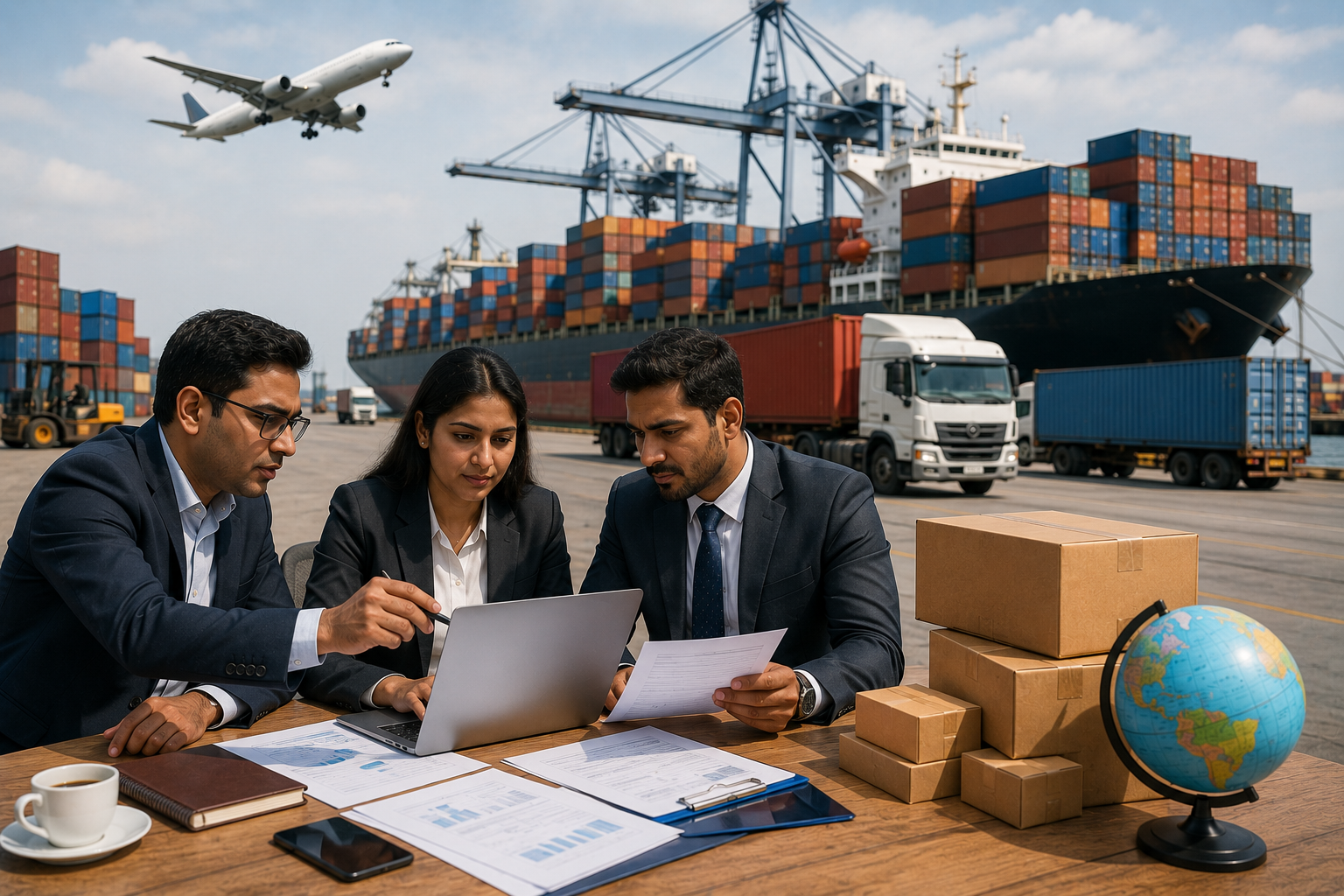
India is launching a nationwide FTA utilisation drive to help MSMEs, first-time exporters and businesses across districts convert preferential market access into actual export opportunities.
KEY TAKEAWAY
India is shifting attention from simply negotiating Free Trade Agreements to ensuring that businesses actually use the market access created by those agreements.
Commerce and Industry Minister Piyush Goyal has called for a nationwide FTA utilisation drive covering MSMEs, first-time exporters, traders, entrepreneurs, startups and women entrepreneurs across India’s districts.
According to the Government, India’s nine FTAs cover economies representing approximately US$60 trillion in GDP and provide preferential access to nearly two-thirds of global trade.
For exporters, however, the commercial value of an FTA depends on much more than the headline tariff. Rules of origin, Certificate of Origin requirements, product standards, pricing, quality, packaging and delivery remain critical to converting preferential market access into actual business.
Why India Is Focusing on FTA Utilisation
India has been expanding its network of trade agreements to create better access for Indian products and services in international markets.
But signing or implementing an FTA does not automatically produce export orders.
A business needs to know:
- Which market is covered
- Which products receive preferential treatment
- What tariff applies
- Whether the product satisfies the rules of origin
- Which documents are required
- What standards and regulatory requirements apply
- Whether the resulting price is competitive
The Government’s latest initiative is aimed at closing this gap between trade agreement and actual exporter utilisation.
At a national workshop in New Delhi on 3 September 2026, Goyal called for the initiative to reach businesses and entrepreneurs across all 780 districts.
This gives the initiative a practical focus: taking FTA knowledge beyond large exporters and established commercial centres.
India’s FTA Network Is Becoming a Larger Export Tool
According to the Commerce Ministry, India’s nine FTAs cover economies representing approximately US$60 trillion in GDP and provide preferential access to nearly two-thirds of global trade.
The Government also sees additional agreements and deeper market-access efforts expanding India’s future trade footprint.
Goyal said India could potentially gain access to 75% of global trade at rates lower than competitors as new FTAs and market-access initiatives progress.
That 75% figure is a Government-stated potential, not the level of preferential access currently available to Indian exporters.
For businesses, the important issue is therefore not the number of agreements alone, but how effectively those agreements translate into competitive export opportunities.
The Real FTA Question: Does It Make the Exporter More Competitive?
An FTA can reduce or eliminate a tariff, but that does not necessarily make an Indian product competitive.
Exporters also compete on:
- Product cost
- Quality
- Delivery time
- Reliability
- Scale
- Packaging
- Customer service
- Certification
- Logistics
- Payment terms
The Commerce Minister specifically highlighted the importance of comparing India’s tariff position with that of competing countries.
This is particularly important in sectors where buyers can easily switch suppliers.
An Indian exporter may receive a preferential tariff but still lose an order if a competing country enjoys a larger tariff advantage or offers lower costs, faster delivery or more established supply-chain relationships.
FTA utilisation therefore needs to be treated as part of an overall export strategy, not as a tariff exercise alone.
Textiles Show Why Market Access Matters
Textiles provide a useful example of how tariff differences can influence international competitiveness.
According to the Commerce Ministry’s account of the workshop, Indian textile exporters had historically faced challenges competing with countries such as Bangladesh and Vietnam because those suppliers benefited from preferential access in developed markets.
India’s position has improved in several developed markets through recent trade agreements.
But tariff access remains only one part of the equation.
Goyal highlighted scale, quality, diligence, customer trust, timely delivery and packaging as factors that determine whether Indian businesses can convert market access into sustained exports.
The broader lesson is important for MSMEs:
An FTA can open the door, but the exporter still has to compete inside the market.
Which Businesses Need to Pay Attention?
The FTA utilisation drive is particularly relevant to businesses that have not traditionally used trade agreements.
The Government specifically wants the initiative to reach:
- MSMEs
- First-time exporters
- Traders
- Entrepreneurs
- Startups
- Women entrepreneurs
- District-level businesses
This is significant because many smaller businesses may know that India has an FTA with a particular country but may not know whether their own product qualifies for preferential treatment.
The commercial opportunity begins when the business moves from general awareness to product-specific market analysis.
An FTA Does Not Mean Automatic Duty-Free Access
This is one of the most important points exporters need to understand.
A product does not automatically receive preferential treatment simply because India has an FTA with the importing country.
The exporter must satisfy the agreement’s applicable rules of origin.
Rules of origin determine whether goods qualify as originating in the exporting country for preferential treatment. Depending on the agreement and product, requirements can involve criteria such as wholly obtained status, change in tariff classification, value addition and other product-specific conditions.
Therefore, exporters need to examine an FTA at the product level, rather than relying on a general statement that a market has been opened.
Certificate of Origin Is Part of FTA Utilisation
Documentation is another critical part of FTA utilisation.
DGFT’s Common Digital Platform for Certificate of Origin provides a single point of access for certificates of origin across FTAs and PTAs and is designed to support secure, electronic and paperless processing.
DGFT’s system also provides exporters with access to information and procedures relating to preferential Certificates of Origin.
For an exporter, this means that using an FTA involves more than knowing the preferential tariff. The business must also establish that its product meets the applicable origin requirements and complete the relevant certification process.
Several Trade Agreements Are Already Creating Market Access
India’s recent trade-agreement activity has created new opportunities across multiple markets.
The Government’s 3 September workshop highlighted operational agreements and recent developments involving markets including the UK, Mauritius, Oman, UAE and Australia, while additional agreements and market-access initiatives remain in different stages of implementation or development.
The commercial opportunity therefore differs from market to market.
Exporters should not treat every FTA as identical.
Each agreement can have its own:
- Tariff schedule
- Rules of origin
- Product exclusions
- Phase-out periods
- Documentation requirements
- Technical requirements
- SPS/TBT conditions
The correct approach is to evaluate the agreement against the specific product and target market.
India’s Export Target Raises the Importance of FTA Utilisation
The Government has set a US$1 trillion export target for the current year.
According to the Commerce Ministry, India’s exports during April–July reached approximately US$317 billion, around US$36–37 billion higher than the corresponding period of the previous year.
The Minister also noted that exports generally gain momentum toward the end of the calendar year and peak during the January–March quarter.
That makes effective use of existing market access particularly important as Indian exporters plan production, pricing and overseas market expansion.
FTA Utilisation Connects With the Export Promotion Mission
The new FTA outreach drive also fits within India’s wider Export Promotion Mission (EPM).
The EPM has an approved outlay of ₹25,060 crore for FY2025-26 to FY2030-31 and operates through two integrated components:
NIRYAT PROTSAHAN
Focused on improving access to export finance for MSMEs through measures such as interest subvention, export factoring, collateral support and other export-finance interventions.
NIRYAT DISHA
Focused on non-financial export enablers, including:
- Export quality and compliance
- International branding
- Packaging
- Trade fairs
- Export logistics
- Warehousing
- Inland transportation
- Trade intelligence
- Capacity building
The Commerce Ministry describes the EPM as a comprehensive and digitally driven framework intended to strengthen India’s export competitiveness.
This is important because preferential market access has limited value if businesses cannot meet the commercial and compliance requirements of the destination market.
From Districts as Export Hubs to FTA Utilisation
The FTA drive also creates a logical connection with India’s Districts as Export Hubs initiative.
District-level export planning identifies products and services that may have international potential.
FTA utilisation can provide the next layer:
District Product → Target Market → FTA Advantage → Rules of Origin → Compliance → Buyer → Shipment
This creates a more complete pathway from local production to international trade.
For businesses located outside India’s traditional export centres, understanding the relationship between district-level production and international market access could become increasingly important.
What Exporters Should Do Now
Businesses should not wait for a general FTA awareness programme before evaluating opportunities.
An exporter considering a new market should:
- Identify target countries where the product has demand.
- Check whether India has an applicable operational FTA or preferential arrangement.
- Identify the product’s tariff classification.
- Check the applicable preferential tariff.
- Study the relevant rules of origin.
- Understand Certificate of Origin requirements.
- Check SPS, TBT and other regulatory requirements where applicable.
- Compare India’s tariff position with competing countries.
- Calculate landed-price competitiveness.
- Assess packaging, quality and delivery requirements.
- Identify potential buyers, distributors or partners.
The objective should be to convert the FTA from a policy document into an actual commercial market-entry strategy.
FTA Utilisation Could Expand the MSME Export Base
The biggest potential impact of the Government’s initiative may be its ability to bring new businesses into international trade.
An established exporter may already have:
- Trade-agreement specialists
- Customs professionals
- International buyers
- Compliance teams
- Logistics relationships
- Market intelligence
A first-time exporter may have none of these.
For that business, the difference between knowing that an FTA exists and knowing how to use it for a specific product can be substantial.
This is why the Government’s proposed district-level outreach matters.
If information, compliance support, market intelligence and commercial connections reach smaller businesses, FTA utilisation could become part of a broader expansion of India’s exporter base.
The Next Challenge Is Turning Agreements Into Shipments
India has increasingly focused on negotiating and implementing trade agreements.
The next challenge is operational:
Can Indian businesses actually use them at scale?
The 3 September workshop brought together Central Government officials, States and Union Territories, Export Promotion Councils and industry associations. State-focused discussions examined export clusters, products and practical constraints faced by exporters seeking to use FTA benefits.
This signals a shift from:
FTA Negotiation → Market Access → Exporter Awareness → Compliance → Utilisation → Actual Shipment
That final step is where the economic value of a trade agreement is ultimately demonstrated.
What to Watch Next
The success of the FTA utilisation drive should increasingly be visible through measurable outcomes.
Key indicators include:
- Growth in exports to FTA partner markets
- Greater MSME participation
- More first-time exporters
- Increased use of preferential Certificates of Origin
- New products entering FTA markets
- New district-level exporters
- Greater product diversification
- Improved exporter awareness
- Increased use of trade intelligence and market-access tools
The central question is no longer simply:
How many FTAs does India have?
The more important question is:
How many Indian businesses are successfully using them?
India has spent years expanding its network of trade agreements and market-access partnerships.
The next phase is to make that access commercially usable for more businesses — from established exporters to the smallest enterprise seeking its first international buyer.
SOURCE
Primary Source: Ministry of Commerce & Industry / Press Information Bureau — Union Minister of Commerce & Industry Shri Piyush Goyal Calls for Nationwide FTA Utilisation Drive to Expand India’s Global Trade Footprint, 3 September 2026. Official PIB source
Supporting Source: DGFT — Common Digital Platform for Issuance of Certificate of Origin. Official DGFT Certificate of Origin platform
Supporting Source: Ministry of Commerce & Industry — Export Promotion Mission. Official Commerce Ministry EPM source


