

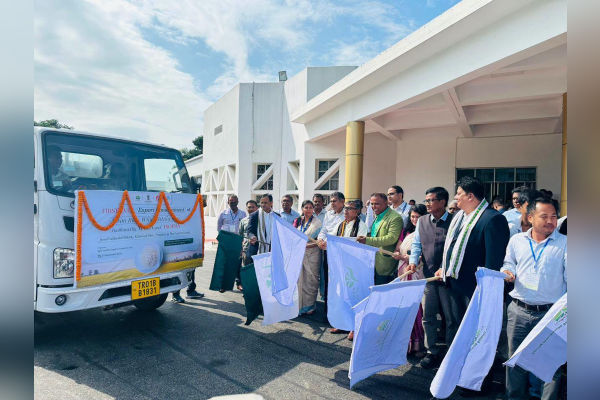
Four NPOP-certified ethnic rice varieties from Tripura have been shipped to Austria and the Netherlands, connecting local Farmer Producer Companies with European buyers and demonstrating how certification, aggregation and buyer linkages can turn regional products into export opportunities.
KEY TAKEAWAY
Tripura organic rice export activity has taken a significant step toward European markets, with an 18-metric-tonne consignment of four NPOP-certified ethnic rice varieties flagged off for Austria and the Netherlands. Facilitated by APEDA, the shipment brings together Farmer Producer Companies (FPCs), organic certification, aggregation, an exporter and international buyers.
The Government says the export opportunity is expected to enable participating farmers to achieve up to 40% higher price realisation compared with the domestic market. The figure is an expected opportunity, not a guaranteed return for every farmer.
From Local Producers to European Buyers
The latest Tripura organic rice export shipment illustrates an increasingly important model for agricultural exports: local producers need more than a product with export potential. They also need aggregation, certification, market linkages, an exporter and logistics capable of meeting international requirements.
The 18-metric-tonne consignment was flagged off on 2 September 2026 for export to Austria and the Netherlands, with APEDA facilitating the shipment.
For Tripura’s farmers and producer organisations, the significance therefore goes beyond one shipment. It demonstrates how a regional agricultural product can move through an organised export chain and reach buyers in international markets.
Four Ethnic Rice Varieties Head to Europe
The consignment contains four varieties of NPOP-certified ethnic rice:
- Aromatic Kali Khasa Rice
- Aromatic Harinarayan Rice
- Biron Rice, described as white sticky rice
- Maimi Hanga Rice, described as black rice
The rice was aggregated from Farmer Producer Companies in Tripura supported by the Tripura State Organic Farming Development Agency (TSOFDA).
The export is being undertaken by M/s Pratithi Organic Foods, Sonepat, which the Government describes as an exporter of Indian organic agricultural products.
Certification Becomes Part of the Export Product
For agricultural exporters targeting international markets, certification is not simply an additional document. It can become part of the commercial proposition.
The Tripura shipment consists of NPOP-certified rice, providing a recognised certification framework for the organic products being exported.
The Government specifically highlighted Austria and the Netherlands as markets where quality, food safety, certification and traceability are important considerations.
This makes the Tripura case relevant to other regional producers seeking to enter premium or specialised overseas markets. A product’s traditional identity may create buyer interest, but consistent certification and traceability help turn that interest into a commercially viable export proposition.
The Buyer-Seller Meeting Came Before the Shipment
The shipment also demonstrates the importance of connecting producers with potential buyers before attempting to scale exports.
In August, APEDA and the Tripura Government organised an International Organic Buyer-Seller Meet in Agartala. The event brought together more than 20 international buyers, 27 exporters and 96 farmers representing 22 FPOs/FPCs, alongside government stakeholders.
The meeting provided an opportunity to discuss sourcing opportunities, market requirements and potential business linkages.
The September rice shipment shows the next stage of that process: turning buyer-seller interaction into an actual international consignment.
Why Aggregation Matters for Small Producers
Small agricultural producers can face difficulties when attempting to serve international buyers individually.
Export markets often require predictable quantities, consistent quality, documentation, certification and coordinated logistics. Farmer Producer Companies can help aggregate production and create a more organised interface between producers and exporters.
In Tripura’s case, the rice was aggregated through FPCs supported by TSOFDA before being exported by an established exporter.
This structure provides a practical example of how local production can be connected to international demand without requiring every individual farmer to independently manage the complete export process.
Europe Creates a Different Standard of Market Readiness
Entering European markets can require exporters to pay close attention to product quality, food safety, certification and traceability.
The Government specifically identified these considerations in relation to the Austria and Netherlands shipment.
For producers of ethnic, traditional or regional agricultural products, this has an important implication: product uniqueness may open the door, but compliance and consistency help keep the door open.
Exporters therefore need to build market readiness alongside production capacity.
Up to 40% Higher Price Realisation Is an Expected Opportunity
One of the potential economic benefits highlighted by the Government is improved farmer returns.
According to the PIB release, the export opportunity is expected to enable participating farmers to achieve up to 40% higher price realisation compared with the domestic market.
This should be understood as an expected opportunity associated with export-oriented production, rather than a guaranteed price premium for every farmer or shipment.
The longer-term commercial question will be whether such export channels can generate repeat orders, maintain quality standards and create sustained demand for Tripura’s agricultural products.
Tripura’s Export Story Goes Beyond Rice
Rice is only one part of Tripura’s potential agricultural export basket.
The recent buyer-seller programme showcased products including Queen Pineapple, GI-tagged Kalikhasa Rice, organic ginger and turmeric, black sesame, jackfruit and scented lemon.
This suggests that the export opportunity for the state could extend across multiple products where regional identity, organic production, GI recognition or distinctive characteristics can create differentiated market propositions.
The challenge is to convert individual opportunities into repeatable export supply chains.
A Practical Export Model for Regional Products
The Tripura organic rice export case can be viewed as a six-stage model:
Local production → Farmer Producer Companies → Certification → Aggregation → Buyer linkage → International shipment
Each stage addresses a different export challenge.
Production creates the product.
FPCs help organise producers.
Certification supports market eligibility and buyer confidence.
Aggregation helps meet commercial quantities.
Buyer linkages create market demand.
Exporters and logistics partners help convert that demand into shipments.
This model can be relevant beyond Tripura, particularly for regional agricultural products that have strong domestic identities but limited international market exposure.
The Connection With Districts as Export Hubs
The Tripura example also fits into India’s broader effort to connect local production with international markets through a district- and region-oriented export strategy.
The Districts as Export Hubs approach focuses on identifying products and services with export potential and strengthening the ecosystem required to take them to international buyers.
Tripura’s rice shipment demonstrates what this concept can look like in practice: a locally produced product is organised, certified, aggregated and connected with overseas demand.
What Agricultural Exporters Can Learn From Tripura
There are several practical lessons for other regional agricultural producers.
First, identify products with a clear market proposition. Traditional or region-specific products can create differentiation.
Second, build export readiness before approaching large international markets. Certification, quality systems, packaging, documentation and traceability need to be considered early.
Third, aggregate supply. International buyers need dependable commercial quantities and consistency.
Fourth, create direct buyer linkages. Buyer-seller meetings can help producers understand market requirements and identify potential commercial relationships.
Finally, focus on repeatability. One shipment demonstrates potential; sustained exports require repeat orders, reliable supply, consistent quality and commercially viable logistics.
The Next Test Is Scale and Continuity
The 18-metric-tonne shipment is an important market-access development, but the larger test will be whether Tripura can build a sustained export pipeline.
That will depend on continued buyer demand, farmer participation, certification, aggregation, quality control, logistics and the ability of exporters and producer organisations to fulfil repeat international orders.
The opportunity is therefore not simply about sending rice to Europe. It is about building the infrastructure and commercial relationships required to make regional agricultural exports repeatable.
What to Watch Next
The next indicators will be whether additional consignments follow, whether international buyers place repeat orders, whether more Tripura products enter overseas markets and whether FPCs can expand their participation in organised export supply chains.
If those developments materialise, the current shipment could become a useful example of how India’s regional agricultural products can move from local production to global markets.
SOURCE
Ministry of Commerce & Industry / Press Information Bureau
APEDA Facilitates Flag-Off of 18 MT of NPOP-Certified Ethnic Rice from Tripura for Export to Austria and the Netherlands, 3 September 2026.


